What are value assessments?
The cost to the consumer of new FDA-approved drugs and medical treatments is set by the manufacturer of the product. However, to establish whether the manufacturer determined price is a fair price, stakeholders (insurers, patients, providers, etc.) need a way to objectively determine the value of the drug.
Value assessments are frameworks to review a drug or treatment, its effectiveness, and the cost in comparison to other drugs or treatments for the same purpose. Value assessments are relatively young in the United States, and frameworks are still being developed and fine-tuned in order to determine the best ways to measure the value of a drug.
One such value assessor is the Institute for Clinical and Economic Review (ICER), an independent, nonpartisan organization that has developed a framework for evidenced-based value assessments of new health technologies. For example, the ICER framework takes a population level perspective – rather than helping each individual patient and provider decide whether a new treatment is valuable for them, the ICER framework aims to provide an overarching assessment of the cost-effectiveness of the drug.
The current ICER framework incorporates the following considerations:
- How well does the drug work?
- Does it work better than what is already on the market?
- How much could it save in healthcare dollars?
- How much would it cost to treat everyone who needs it?
Additionally, the ICER framework includes the following contextual considerations:
- severity of the illness that the treatment is intended for,
- whether it is the first treatment for the condition, and
- the level of uncertainty of the long-term benefits and/or side effects of the treatment
Using these factors, ICER then makes a recommendation for how much the new treatment should cost.
ICER’s Framework for the Review of Products for Ultra-Rare Diseases
In 2017, rare disease community advocates who were concerned that the framework was not designed to produce accurate analyses due to a lack of sensitivity to trial designs and regulatory pathways frequently deployed in rare disease product development, encouraged ICER to re-assess the ICER framework.
Following a nine-month engagement with the rare disease community and other stakeholders, an ICER framework was published in 2017 and updated in 2020 that was modified for assessing treatments of “ultra-rare” conditions (disease prevalence <10,000).
Policy Engagement
The rare disease community has actively engaged in ensuring that patients, providers, and decision-makers within the access environment are empowered with evidence-based resources to inform decision making around which products are appropriate for which patients at which stage of disease progression.
To that end, valuations may serve as an additional resource within the access ecosystem. However, value assessments should not be utilized as a singular tool for patient access to approved products to be hindered.
The rare disease community is committed to working with stakeholders and partners within the value assessment space to address limitations of current frameworks to address:
Patient-Informed Value
Thanks to decades of advocacy, funding, and innovation, our healthcare landscape is rapidly changing. As new therapies emerge into the marketplace, patients, providers, and payers are faced with challenges as to how to discern which therapies are most appropriate for which patients in which combinations and which time. To facilitate this decision, an attempt to define the ‘value’ of specific interventions is made. An entire sector exists around this definition of ‘value.’ But – to date – the frameworks and data used to assess a product’s value have not traditionally been based on values anchored on patient community experiences. Value assessment frameworks have been criticized for the lack of inclusion of patient experience data, including the outcomes that matter most to patients. Frameworks need to include patient and caregiver values as central within their modeling, and not simply contextual considerations.
Quality Adjusted Life Year (QALY)
QALY is a health economic measure of outcomes that is considered a ‘gold standard’ by ICER and other policymakers but is considered unethical by much of the rare disease community. The QALY is a calculation that combines morbidity (quality of life) with mortality (quantity of life) to estimate the value of specific health interventions. A year of life lived in perfect health is worth one QALY. A year of life lived in a state of less than perfect health is worth less than one QALY. Death is valued at zero. Someone with a life-limiting diagnosis or disability would have a QALY value less than one, greater than zero relative to a subjective valuation of the level of disability. The use of QALY inherently devalues the quality of life of people with disabilities by assigning a lower QALY than that of someone without a disability or diagnosis. The QALY assumes that a year in the life of someone with a rare disease is not as valuable. The QALY also does not allow for changing patient preferences.
Studies on the Economic Impacts of Rare Diseases
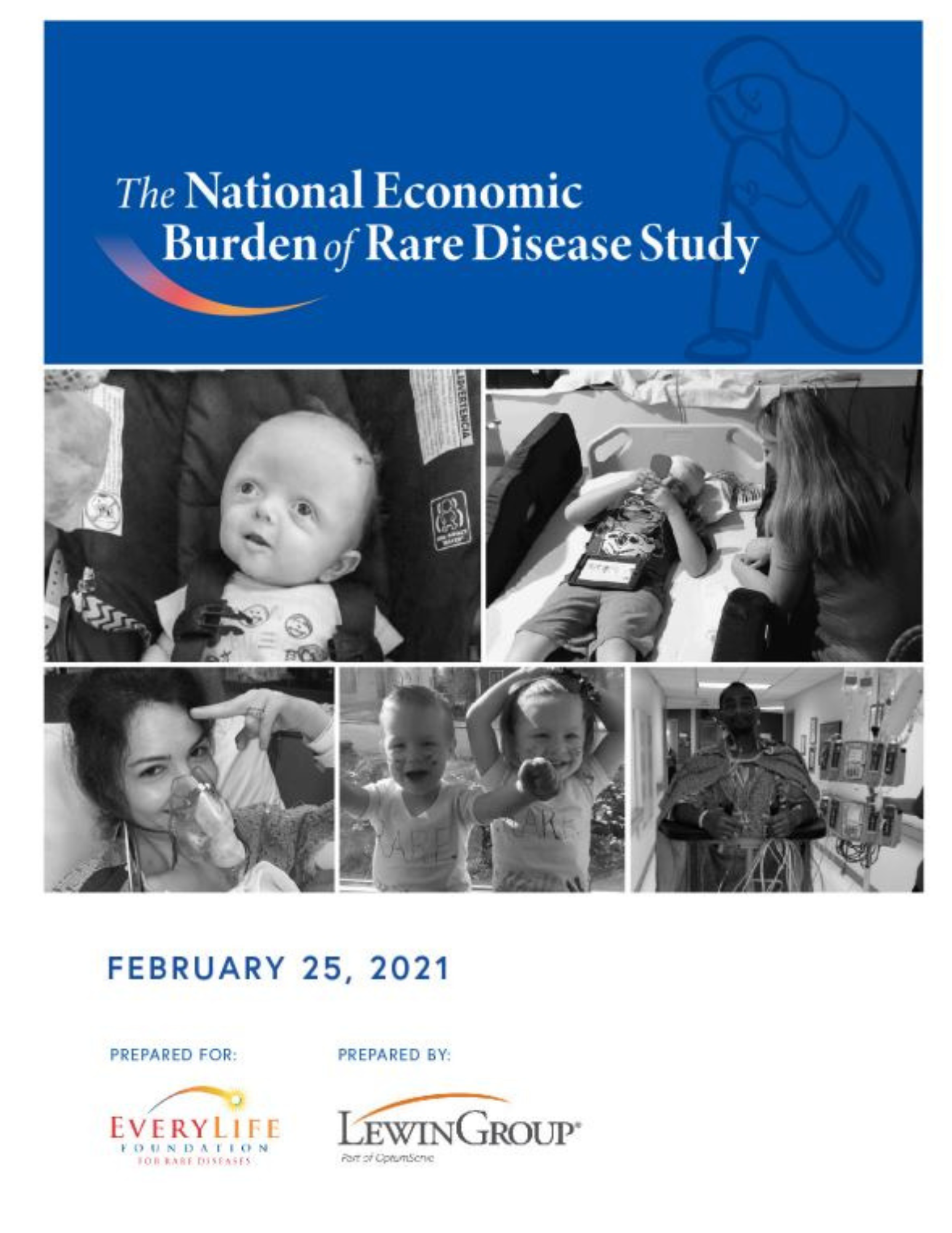
This study provides the most comprehensive assessment of the total economic burden of rare diseases (RDs) in a single year.
This groundbreaking new study shows the cost savings of receiving a more timely diagnosis in rare disease.
Help us amplify the voices of the rare disease community to drive meaningful change and influence policy.