Understanding how patient and payer communications can lead to both compliance and confidence in the healthcare experiences of the rare disease community.
Patient and Payer Engagement
Patient engagement transforms health care decisions by building better benefits, smarter coverage policies, and patient care grounded in real-world experiences. When payers integrate patient experiences into benefits, coverage, or care delivery, policy determinations offer greater value to members.
Federal regulations for some types of health insurance now require substantive patient engagement to inform decisions regarding insurance benefits, coverage, and care delivery. With these rules going into effect in 2025 and 2026, it’s no longer a “nice-to-do,” it’s a “must-do.”
Done well, engaging patient representatives to inform payer decision-making can:
- Improve health outcomes
- Reduce appeals and member and provider friction
- Boost member satisfaction
- Create programs and policies that reflect community needs and communication preferences.
However, patients, patient organizations, and payers alike are asking where to start:
- For individual representatives: Publicly sharing their personal experiences can be daunting, reflecting population experiences can be challenging, and balancing lived experiences with complex clinical, economic, and regulatory requirements isn’t easy.
- For patient organizations: Terminology may be unfamiliar, information needed to inform payer decisions are not well understood, and opportunities to engage with payers are hard to identify and navigate.
- For plans and Medicaid groups: Tight timelines, resource concerns, economic and regulatory requirements, and limited tools make it challenging to integrate patient experience evidence alongside clinical and economic data.
The RARE Foundation can help. Click on the applicable button to learn more and get ready to engage.
For Patients and Families
Patient engagement isn’t just an emerging trend — it’s now a requirement. Federal rules now direct state Medicaid agencies and many health plans to include patient voices to inform health insurance benefits, coverage, and care delivery. This means your experiences — and the experiences of people like you — are essential in these decisions.
How You Can Engage
There are many powerful ways for patients and caregivers to make their voices heard and guide decisions about coverage, reimbursement, and care.
- Share your experience through research. Engage in your community’s research or surveys that document the patient journey, experiences, and unmet needs. Time commitments vary by project.
- Apply to serve on your state’s Medicaid Beneficiary Advisory Council (BAC). If you receive Medicaid benefits or care for someone who does, you can help shape how your state delivers services to improve access, quality, and effective care. If selected, the typical commitment is two to four hours plus preparation for each bi-monthly or quarterly meeting over a one- to three-year appointment.
- Testify at your state’s Medicaid Advisory Committee. Many Medicaid policies and programs are changing. Public comment sessions are open to all patients and caregivers, this gives you a chance to share your experiences and influence decisions that affect your Medicaid coverage and access to care. Meetings are scheduled on a bi-monthly or quarterly basis, and written feedback or brief public statements (lasting three to five minutes) are welcome.
- Serve on a health plan’s Pharmacy & Therapeutics (P&T) Committee. Health plans, and specifically plans sold on the health exchanges, are seeking patient representatives to join multidisciplinary groups that review clinical and economic evidence to determine which treatments are covered, how they are used, and for whom. Typical time commitments, if selected, are four to eight hours plus preparation for monthly or quarterly meetings, depending upon the health plan.
Learn about Medicaid Committees
State Medicaid programs are actively seeking patients and caregivers to serve on their Beneficiary Advisory Councils (BAC). If you, a family member, or someone who supports your care receives Medicaid coverage, you can help guide how your state delivers services.
What to expect:
- Each state has its own application process.
- Applications are simple and typically take less than 10 minutes.
- You may be asked about your demographics (age, gender, county, services you use) to ensure the BAC reflects their state’s population, your availability (e.g., evenings vs. daytime availability), your experience with Medicaid services and opportunities for improvement, and why you’d like to participate.
- Many states offer modest stipends, travel reimbursement for in-person meetings if required, and additional support to enable your participation.
- Beneficiary Advisory Councils and Medicaid Advisory Committees Explainer
Federal Requirements
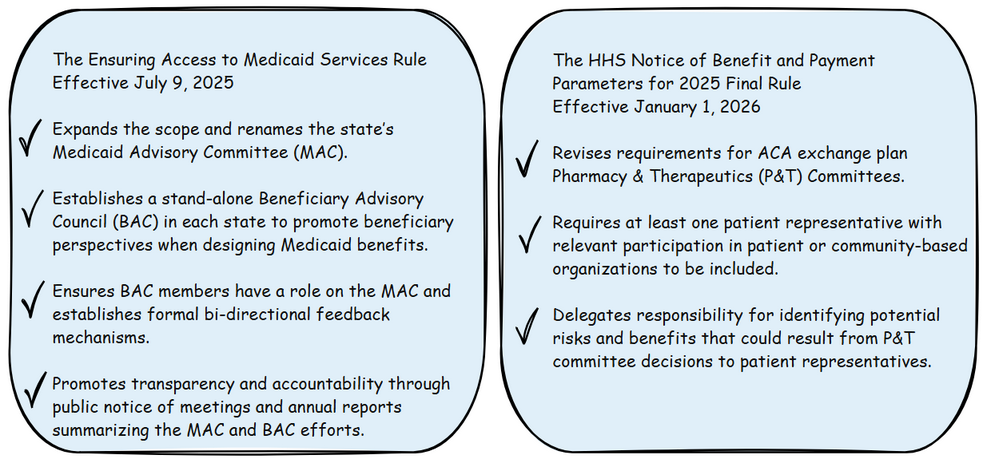
In 2024, the Centers for Medicare and Medicaid Services (CMS) finalized two major rules requiring states and health plans to formally integrate patients’ voices into decisions about medical care and drug coverage. These rules, effective in 2025 and 2026, strengthen and expand patient representation in payer decision-making.
Search for Opportunities to Engage
Use the state-by-state directory to find open applications, upcoming deadlines, and other information.
Additional Patient Resources
- Glossary for Patients. As you or your members engage with payers, you may come across new terms. This glossary explains terms in plain language to help you navigate coverage and payment discussions with confidence. View Glossary
- Connect for Support. Were you selected to serve on a Beneficiary Advisory Council or a health plan P&T committee? You don’t have to navigate this alone. Contact info@rareadvocates.org to connect with others, understand meeting processes, and get tips for effectively communicating your perspectives.
- MACBAC Application Process
- Preparing to engage on a MACBAC
- Healthcare Decision Making for Young Adults with Rare Diseases – A Resource Guide
- RDLA Policy Primer: Types of Insurance Regulation and Advocacy Strategies
- Policy Primer: The Affordable Care Act (ACA)
For Payers
How Patient Engagement can be Transformative
Patient engagement transforms healthcare coverage by building better benefits, smarter policies, and patient care grounded in relevant and lived experiences. Patient input helps design benefits that work for your population, reducing friction, improving adherence, and building trust. And with new federal requirements, it’s no longer a “nice-to-do” and now a regulatory “must-do.”
The Challenge?
Your organization makes coverage and payment decisions fast and often. Engaging patient organizations across all health conditions can be resource intensive. And turning lived experience stories into data that can sit alongside clinical and economic spreadsheets is hard.
We’ve heard from other payers that your organization needs to know:
- Credibility: How do we know this organization is transparent about potential conflicts of interest and trustworthy?
- Capability: Does the organization (or representative) have the knowledge, preparation, and support to engage in discussions alongside other experts — while keeping the focus on patient impact?
- Relevance: Will their input reflect not only their personal experience but the needs and perspectives of the broader covered population?
- Feasibility: How can we efficiently identify, partner, and integrate patients in ways that align with existing decision-making processes and timelines?
- Meaningful: What tools, support, and best practices will help ensure patient experience data isn’t just a check-the-box requirement, but instead becomes a trusted input to strengthen decisions?
We know these challenges are real — that’s why the RARE Foundation created tools and frameworks to help your organization get started. Don’t see what you are looking for? We are eager to hear from you and learn what additional support you need to enhance your engagement with patient representatives and consideration of patient experience data. Contact our Policy Team at policy@rareadvocates.org to connect with patient organizations and access tools and resources to make patient engagement more meaningful, effective, and sustainable.
Federal Requirements
In 2024, the Centers for Medicare and Medicaid Services (CMS) finalized two major rules requiring states and health plans to formally integrate patients’ voices into decisions about medical care and drug coverage. These rules, effective in 2025 and 2026, strengthen and expand patient representation in payer decision-making.
Federal regulations for some types of health insurance now require substantive patient engagement to inform decisions regarding insurance benefits, coverage, and care delivery. With these rules going into effect in 2025 and 2026, it’s no longer a “nice-to-do,” it’s a “must-do.”
Regulation Summary
Resources to Help You Engage Patients
Better patient engagement requires finding patients who can share their perspectives AND reflect the experiences of typical patients. Trusted sources can help your organization more quickly find individuals and groups ready to engage.
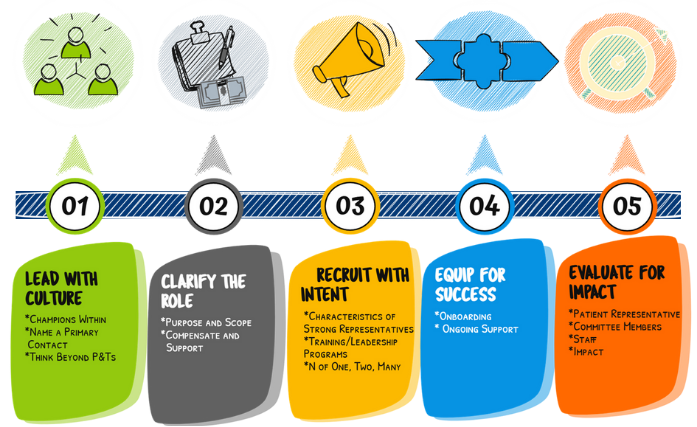
A Guide to Embedding Patient Experience in Managed Care Pharmacy
Lessons for good and better practices from Medicaid Beneficiary Advisory Councils.
Beyond the Unicorn: Finding Ready-to-Engage Patient Representatives
- Where to find patient representatives: Training programs and pipelines prepare patients to engage in regulatory, research, and policy committees and councils.
- What to look for: Key characteristics of patient representatives who balance personal experience with population needs.
Credible, Capable, and Ready to Engage: A Three-Step Guide for Health Plans to Identify Patient Organizations for Engagement
This tool helps you:
- Assess organizations: A step-by-step framework to evaluate patient groups for credibility, representativeness, and focus on patients.
- Avoid the N-of-1 pitfalls: Move beyond n-of-1 perspectives or individual stories on social media to help inform the needs of population health n-of-many perspectives across patients and different conditions.
- Build a trusted patient network: A network of reliable organizations ready to help inform decisions.
Payer Engagement Glossary
A reference guide defining key terms and concepts commonly used in payer engagement, managed care, and healthcare access discussions. This glossary is intended to support clearer communication between patient advocates, healthcare stakeholders, and payer organizations.
Latest Updates
- EveryLife submitted comments to CMS about their proposed changes to the health equity and utlization management components of the proposed rule on Medicare Advantage and the Medicare Prescription Drug Benefit
- Rare Disease Community Wins Victory Over Oregon’s Harmful Accelerated Approval Proposal
- The EveryLife Foundation Responds to Comments on Proposed Rules (FDA and CMS)
Help us amplify the voices of the rare disease community to drive meaningful change and influence policy.