Groundbreaking Study Reveals Staggering Economic Toll of Delayed Rare Disease Diagnosis
Report Calls for Urgent Advancements in Policies and Technologies
“The results of this study demonstrate the urgent need for implementation of faster and improved diagnostic strategies to help decrease the financial and personal impact on families and the healthcare system.”
– Annie Kennedy, Chief of Policy, Advocacy, and Patient Engagement, the RARE Foundation
A delayed diagnosis worsens outcomes and has a significant financial impact on families, including paying for doctor visits, medical equipment, prescriptions, and transportation that could have been avoided. People living with rare diseases deserve continued advancements in policies and technologies that support better screening and timely diagnosis.
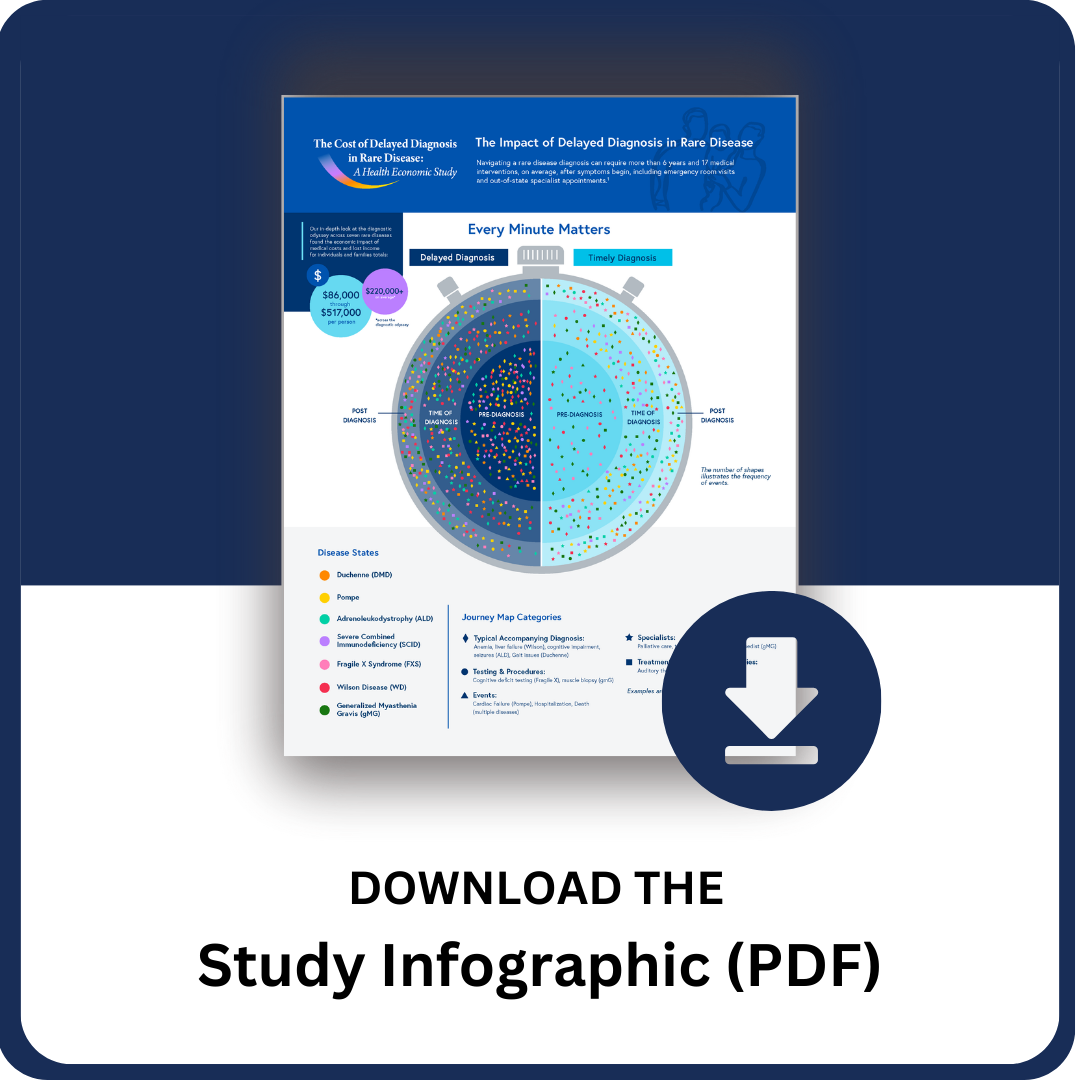
About the Study
The Cost of Delayed Diagnosis in Rare Disease: A Health Economic Study is a landmark report showing the cost savings of receiving a more timely diagnosis in rare disease.
The economic impact of a delayed diagnosis is up to $517,000 in avoidable costs per patient. Shortening the more than six-year average diagnostic odyssey saves money for individuals, caregivers, and the healthcare system, while improving health outcomes by:
- Providing earlier access to supportive therapies and treatment
- Delaying or preventing disease complications and physical disabilities
- Reducing or eliminating costly and unnecessary services or procedures
“Medical costs for rare diseases are inevitable, but avoidable costs from delayed diagnosis not only place financial strain on individuals and families but also divert crucial healthcare funds. These could be better used for treatments that enhance patient quality of life and boost workforce productivity.”
– Amy Brower, PhD, Former Director of Newborn Screening Translational Research Network at American College of Medical Genetics and Genomics
On average, it takes more than 6 years, and nearly 17 doctor visits, hospitalizations, and other health-related trips, to receive a rare disease diagnosis after symptoms begin.
The National Economic Burden of Rare Disease Study estimated the economic cost of rare diseases at nearly $1 trillion U.S. dollars.
“The sooner you get the diagnosis and the sooner you get treatment and supportive therapies, the better…the driving force for outcomes really is early diagnosis. Time is muscle.”
– Paloma Juarez, whose children live with Pompe disease
This follow-up study looks in depth at avoidable costs across seven rare diseases. For a deeper understanding of the diagnostic odyssey, the following links outline the typical patient journey for people who received a timely diagnosis vs. a delayed diagnosis in the following rare diseases:
- Adrenoleukodystrophy (ALD)
- Duchenne Muscular Dystrophy (Duchenne)
- Fragile X Syndrome (FXS)
- Myasthenia Gravis (gMG)
- Pompe disease
- Severe Combined Immunodeficiency Disorder (SCID)
- Wilson disease
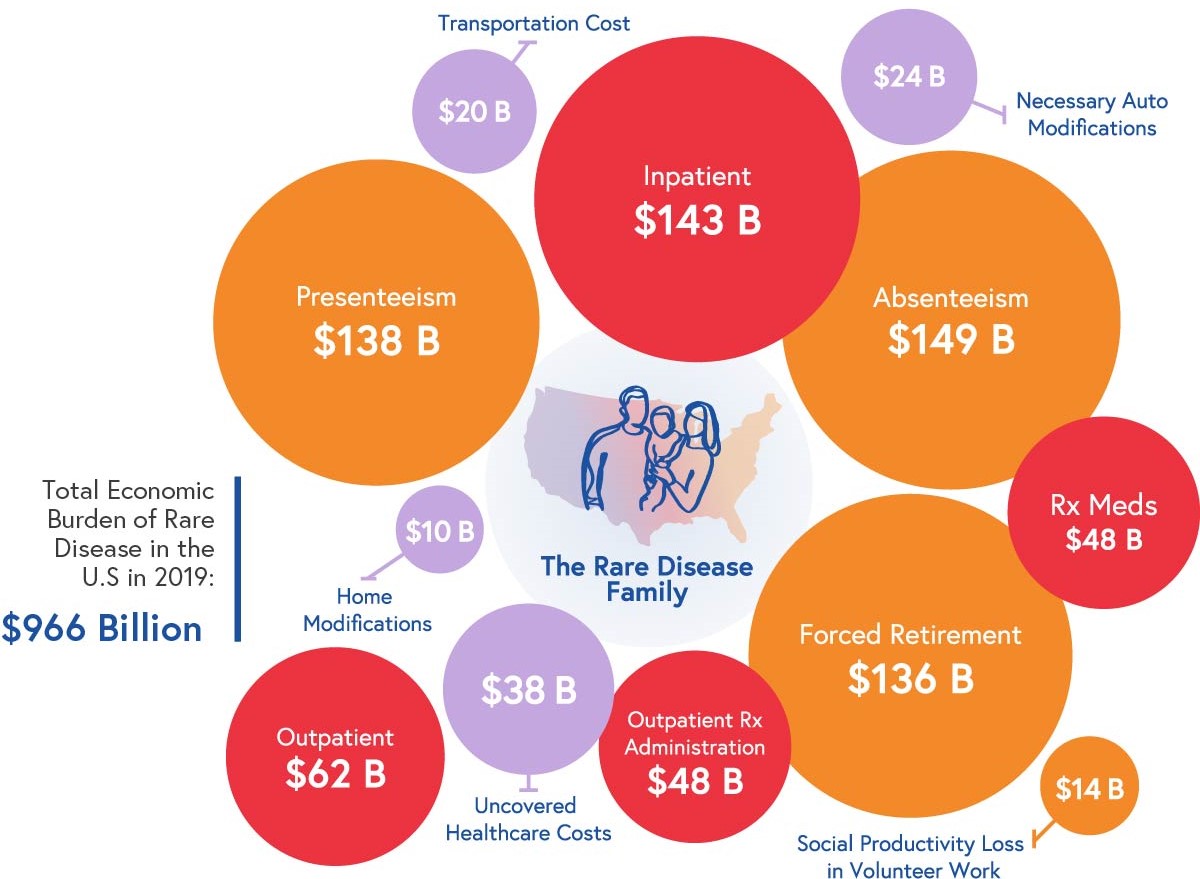
The RARE Foundation’s seminal Economic Burden of Rare Disease study revealed the impact of rare disease to be nearly $1 trillion dollars in 2019.
Read about this study’s findings and why we must act with urgency to address the rare disease public health crisis.
Study results provide evidence to support federal and state policies expanding diagnosis and treatment options for all rare diseases.
What We Found

Direct Medical Costs
Examples
- Inpatient or outpatient care
- Physician visits
- Rx medications and their administration
- Durable medical equipment
Private and public insurance programs typically pay providers directly, and patients are responsible for co-pays
Indirect Costs: Productivity Loss
Examples
- Forced retirement
- Absenteeism
- Presenteeism (when employees cannot fully function in the workplace)
- Reduction in community participation and volunteer service
Reduces income for patients and caregivers, while reducing productivity for employers, communities, society

Non-medical Healthcare Costs
Examples
- Necessary home or auto modifications
- Transportation and education costs
- Paid daily care
- Healthcare services not covered by insurance: experimental treatments, medical foods, and more
Out-of-pocket costs are absorbed directly by families living with RD
On average, the diagnostic odyssey for a rare disease patient costs over $220,000 in avoidable medical bills and lost income.
Medical + Indirect + Non-Medical = The Total Costs
It’s vital to screen newborns to ensure that all infants can benefit from recent medical advancements. Timely detection of Duchenne not only helps in diagnosing the condition before symptoms appear but also in starting treatments that offer the best long-term outcomes medically and financially.
– Pat Furlong, Founding President and CEO of Parent Project Muscular Dystrophy (PPMD)
The economic cost, including direct and indirect costs, of delayed diagnosis in these seven diseases is between $86,000 and $517,000 per person. Across all diseases, a timelier diagnosis reduces the economic burden.
Direct Medical Costs
In ALD, Pompe, and SCID…
Newborn screening (NBS) has been implemented nationally for these conditions, eliminating the diagnostic odyssey and resulting in no medical costs before the first year of diagnosis. Even with NBS, annual medical costs attributed to delayed diagnosis of ALD, Pompe, or SCID ranged from $46,000 to $87,000 per person.
For Fragile X Syndrome and Duchenne Muscular Dystrophy…
The economic burden, including medical costs and productivity loss, is 12-fold and 4-fold greater, respectively, with a delayed diagnosis compared with timely.
As shown in this study, timely diagnosis is essential to prevent disease complications, but even a timely path can still be improved. Advancements in technologies to screen, diagnose, treat, and manage rare diseases have the potential to dramatically shorten, or even eliminate, the diagnostic odyssey.
What Can You Do?
Make your voice heard: Engage, share your story, and get involved in advocacy.
I had 30 years of progression before I was diagnosed. Many procedures done across multiple decades missed it. If I received a timelier diagnosis, I could have skipped a number of unfun tests, including liver biopsies, endoscopy, muscle biopsy, and regular blood testing.
– Ryan Colburn, who lives with Pompe disease
These findings demand attention from researchers, policy makers, healthcare providers, and employers. There is an urgent need to fund research, enhance awareness, and improve access to diagnosis, care, and treatment of rare disease. Contact your elected representatives, share the study findings, and urge Congress and state governments to enhance newborn screening and other policies that facilitate patient access to diagnosis and treatment.


Press Coverage
| October 27, 2023 | New Study for Policy Makers Documents the Burden of the Diagnostic Odyssey on Rare Disease Families |
| October 9, 2023 | CheckRare, Delayed Diagnosis Caused By Excess Costs |
| September 27, 2023 | Newborn Screening Can Lessen the Toll of Rare Disease on Patients and Families |
| September 15, 2023 | Express Healthcare Management, The Cost of Delayed Diagnosis in Rare Diseases: Study Finds Early Diagnosis Could Save $500,000 per Patient |
| September 15, 2023 | Inside Precision Medicine, Early Rare Disease Diagnosis Could Save as Much as $500,000 per Patient |
| September 15, 2023 | Global Genes, New Study Measures Economic Impact of Delayed Diagnosis of Rare Diseases |
| September 14, 2023 | BioCentury, Study quantifies costs of delayed diagnosis of rare disease |
| September 14, 2023 | BioSpace, Foundation Study Measures Economic Impact of Delayed Diagnosis of Rare Diseases |
Study Contributors
Lewin Group Project Staff
Emily D. Parker, PhD, MPH
Emily Myers, MPH
Nwanneamaka Ume, MPH
Sam Kallman, BA, BS
Grace Yang, MPA, MA
RARE Foundation Project Staff Leads
Annie Kennedy, BS, Chief of Policy, Advocacy and Patient Engagement
Jack Meloro, Policy Programs Manager
Technical Advisory Group
Annie Kennedy, RARE Foundation
Niki Armstrong, MS, CGC, Parent Project Muscular Dystrophy
Amy Brower, PhD, American College of Medical Genetics, Creighton University Medical School,
University of Nebraska Medical Center
Khrystal Davis, Texas Rare Alliance
David J. Eckstein, PhD, National Institutes of Health
Ryan Fischer, Foundation for Angelman Syndrome Therapeutics (FAST)
Monique Griffin, Pompe disease community member
Meghan C. Halley, PhD, MPH, Stanford Center for Biomedical Ethics, The Undiagnosed Diseases Network Foundation
Maggie Jalowsky, Sick Cells
Paloma Juarez, odimm, inc
Sarah Marshall, Undiagnosed Diseases Network
T. Joseph Mattingly, PharmD, PhD, MBA, University of Maryland School of Pharmacy
Nancy J. Mendelsohn, MD, Principal, NJMendelsohn Consulting
Robert Mitchell-Thain, Global Liver Institute
Hilary Rosselot, National Fragile X Foundation
Sean Tunis, MD, MSc, Rubix Health
Ashley Valentine, Sick Cells
SmithSolve Leads
Chris Smith President & CEO
Kathleen Hayes, MPH
Logan Ruppel, MA
Expert Contributors
Don Bailey, PhD, RTI International
Barb Ballard, SCID Angels for Life Foundation
Ryan Colburn, odimm, inc
Brenda Colmenares, RARE Foundation
Lindsey Cundiff, RARE Foundation
Courtney Felle, RARE Foundation
Richard Finkel, St. Jude Center for Experimental Neurotherapeutics
Brenda Finucane, MS, LGC, Geisinger University
Danny Hiles, Wilson Disease community member
Elizabeth Berry-Kravis, MD, PhD, RUSH University
Miranda McAuliffe, MPA, ALD Alliance
Brian Meltzer, MD, MBA, Alexion Pharmaceuticals
Margo Metzger, EveryLife Foundation for Rare Diseases
Meridith O’Connor, MSW, Myasthenia Gravis Foundation of America
Mena T. Scavina, DO, Nemours Children’s Health
Rachel Schrader, MS, APRN, CPNP-PC, Parent Project Muscular Dystrophy
Elisa Seeger, ALD Alliance
Dylan Simon, MS, EveryLife Foundation for Rare Diseases
Heather Smith, SCID Angels for Life Foundation
Jamie Sullivan, MPH, EveryLife Foundation for Rare Diseases
Jayne Dixon Weber, National Fragile X Foundation
Anne Wheeler, PhD, RTI International
Study Funding Support Provided By:
Alexion Pharmaceuticals
Amicus Therapeutics
Argenx US, Inc.
Chiesi Global Rare Diseases
Danaher Foundation
Genentech
Invitae Corporation
PhRMA
Pfizer Inc.
REGENXBIO Inc.
Sanofi
Ultragenyx Pharmaceutical