Our fight to reauthorize the Rare Pediatric Disease PRV Program continues. Please join us in urging your members of Congress to reauthorize this critical program by passing the Give Kids a Chance Act of 2025 (H.R. 1262/S.932) in the House and a soon-to-be-introduced companion in the Senate.
Progress has been made in the effort to extend the Rare Pediatric PRV Program, but Congress’ job is not done yet. On September 23, 2024, the House unanimously passed the Give Kids a Chance Act which included the Creating Hope Reauthorization Act of 2024, the original bill to reauthorize the PRV Program last Congress.
In late December 2024, a bipartisan healthcare policy package, including the Give Kids a Chance Act, was released and set to be included in the end-of-year government funding extension. Due to forces unrelated to the healthcare policy package or the rare disease community, most health provisions, including the PRV Program, Accelerating Kids Access to Care Act, and cancer research funding, were excluded from the final bill. Unfortunately, the Pediatric Rare Disease Priority Review Voucher Program expired on December 20, 2024.
Here are three ways you can take action and help give kids hope:
If you’ve met with your senator or their staff in previous advocacy efforts and have their personal emails, please reach out directly to explain why supporting the Give Kids a Chance Act is essential. If you don’t have direct contact, you can still make your voice heard through this action alert here.
Target your Member of Congress using the template message below and find the official social media handles for your senator here.
Suggested Message: “Senator [@mention], the Give Kids a Chance Act is critical for extending the Rare Pediatric Priority Review Voucher Program and giving children with rare diseases a fighting chance. Please support this life-saving legislation. #Cures4RareKids.”
Use these resources to ask your community to take action with your community—friends, family, colleagues, and advocacy networks. The more people who contact their senator, the better our chances of passing this life-saving legislation.
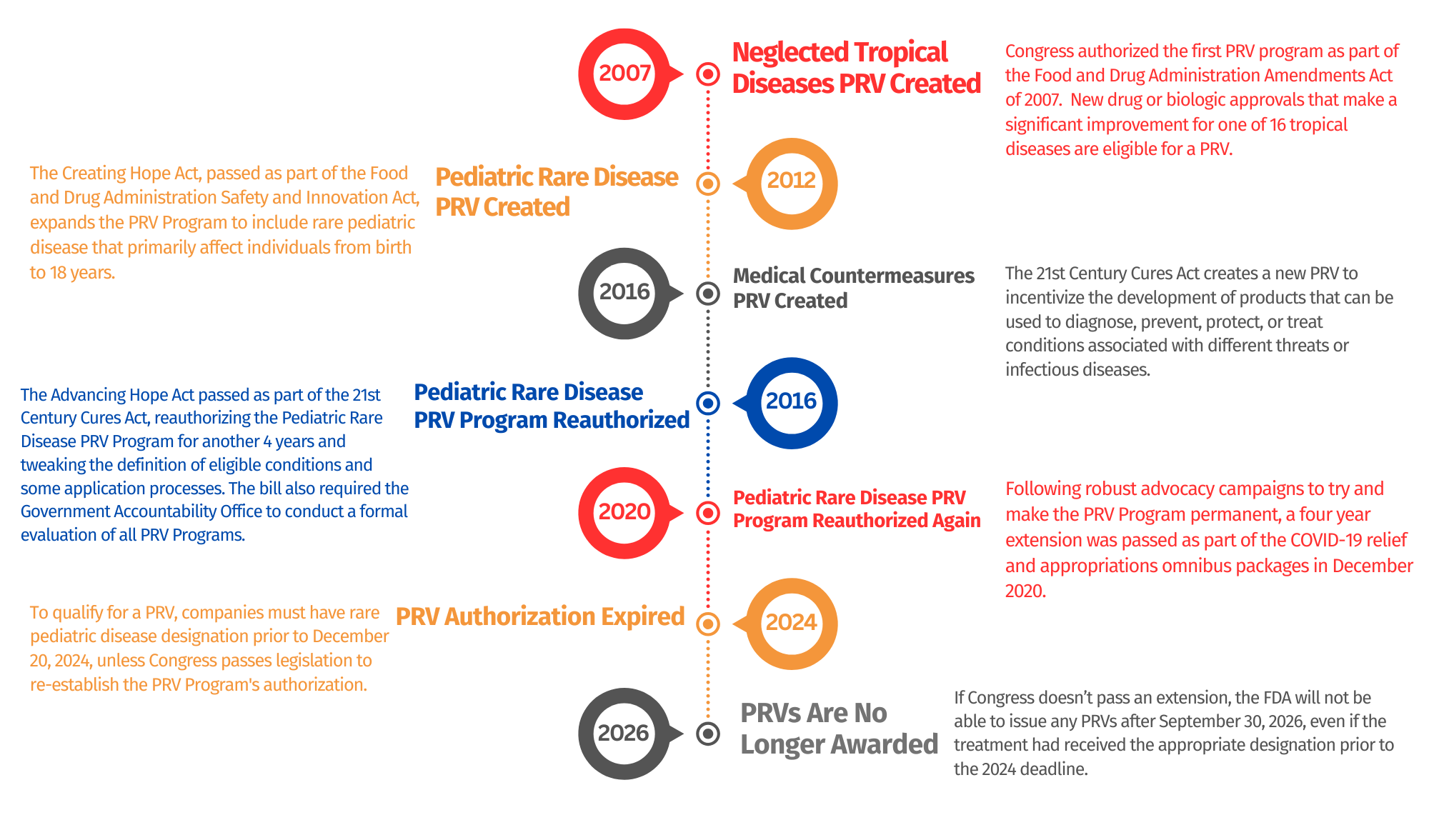
The priority review voucher (PRV) program was expanded to include drugs that treat rare pediatric diseases in the Food and Drug Administration Safety and Innovation Act (FDASIA) in 2012. The purpose of the PRV is to expedite the development and promotion of drugs in the rare pediatric disease, tropical disease, and medical countermeasure fields.
Developing drugs for rare pediatric diseases is particularly challenging due to the small populations affected, difficulties associated with conducting clinical trials for children, delays in diagnosis and more. A majority of PRVs have gone to rare pediatric disease drugs, meaning the program has a large impact on the rare disease community.
The PRV program incentivizes pharmaceutical companies to develop a rare pediatric disease treatment. Before a treatment is approved, the company can obtain Rare Pediatric designation from the FDA. To be eligible, the drug must be eligible for priority review, and it must be the first approval for the drug’s active ingredient.
After an eligible treatment is approved by the FDA, the company is issued a PRV that can be used to obtain priority review for a treatment that wouldn’t otherwise qualify. Priority review means a treatment is generally reviewed by the FDA within 6-months rather than the standard 10-month period.
Once issued by the FDA, PRVs can be used by the company on a future treatment that wouldn’t otherwise be eligible for priority review or it can be sold to another company, generating revenue for the seller. The revenue that they generate from selling a PRV is part of the incentive for companies to invest in developing treatments for rare pediatric conditions. Companies purchase PRVs so that they can get treatments on the market faster than the typical 10-month review period.
- Developing drugs for rare pediatric diseases is challenging due to the small populations affected, difficulties associated with conducting clinical trials for children, delays in diagnosis and more.
- About 70% of rare diseases are exclusively pediatric onset and overall, 95% of rare diseases have no approved treatments.
- The impact of the PRV program has continued to increase since the last reauthorization. A new incentive takes time to fully impact decision making since it takes an average of 15 years for a drug to be developed and approved by the FDA.
- 58 Rare Pediatric PRVs have been issued since 2012 for innovative treatments in over 40 diseases like spinal muscular atrophy, Duchenne muscular dystrophy, and progeria syndrome.
- 7 out of 7 drug developers interviewed by the GAO reported that PRVs were a factor in drug development decisions.
Dear Rare Disease Community (PRV Intro Letter)
- PRV Fact Sheet
- Action Alert
- Congressional Letter for the Creating Hope Reauthorization Act of 2024
- PRV One-Pager
- Communities Impacted by the PRV Program
- Links to Additional PRV-Related Resources
- PRV Policy Primer
- List of Social Media Templates
- PRV Claims and Counterpoints
- I am Bio Podcast- How Love Combined with Science Leads to Hope for Rare Disease
- Community Congress Toolkit Announcement
- Support for the Give Kids a Chance Act of 2025 – Letter
- EveryLife Foundation Applauds the Introduction of the Creating Hope Reauthorization Act of 2024 – Urges Congress to Act Swiftly – EveryLife Foundation for Rare Diseases
- Why reauthorization of the Rare Pediatric Disease Priority Review Voucher (PPRV) Program is vital