Challenges to Diversity in Rare Diseases
- Systemic Discrimination
- Lack of Knowledge of Available Services
- Lack of Representation in Rare Disease Spaces
- Lack of Diversity in Clinical Trials
- Unconscious Provider Bias
- Fewer Health Providers from Underserved Communities
- Language Barriers
- Indirect and Direct Costs of Advocacy
- Costs of Healthcare Services
- And more
Rare Diseases and Barriers to Care: In the United States, at least 30 million Americans are living with one or more rare disease. A disease is defined as rare when it affects fewer than 200,000, with an estimated 10,000 different diseases falling under the rare classification according to an article published by the National Library of Medicine.
Underserved rare disease community members may face increased barriers to care and inclusion throughout and following their diagnostic odyssey. Due to systemic, linguistic, and socio-economic challenges, diverse communities are more likely to have delays and greater chances of hospitalization from preventable conditions.
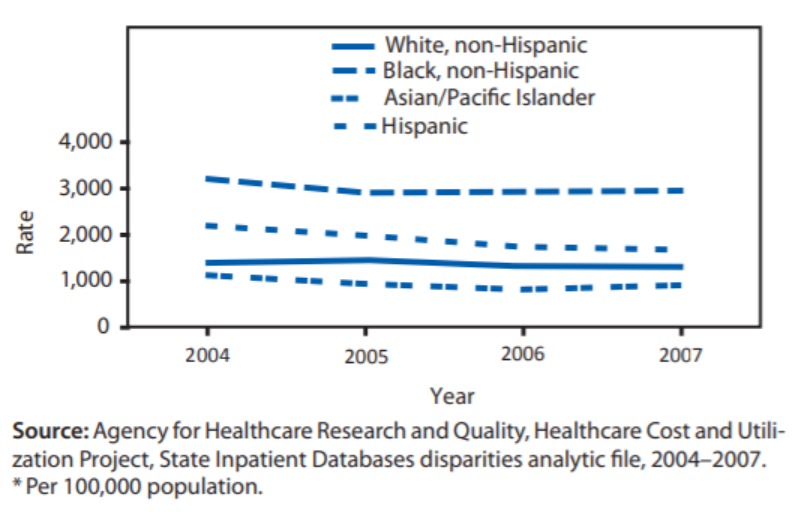
Disparities at Home: By understanding the health equity issues facing underserved community, organizations and diverse rare disease patients can become more empowered to confront the root causes of discrimination and disenfranchisement in the United States. For example, during 2004–2007, the adjusted rate of preventable hospitalizations was higher among non-Hispanic blacks and Hispanics, compared with non-Hispanic whites according to the 2011 CDC Health Disparities and Inequalities Report.
“If non-Hispanic blacks had had the same adjusted rate of preventable hospitalizations as non-Hispanic whites, they would have had approximately 430,000 fewer hospitalizations”
Further Reading: The following information covers how rare diseases impact our most underserved communities and how health, equity, and inclusion disparities shape the diagnostic, treatment, and curative process for diverse patients living with rare diseases. Underscoring the barriers to care shown in the preventable hospitalization information, systemic discrimination and unconscious bias in the medical space can contribute to an even more arduous diagnostic odyssey for diverse rare disease patients.
Barriers to Treatment: Barriers to treatment exist for many underserved communities, and individuals, preventing equitable access to medications or procedures due to preexisting bias of lack of access. This is especially worrisome for Rare Disease Patients like those in the Sickle Cell community, which has a high prevalence in the Black Community, who face pain crisis as symptom. Due to bias, patients reporting pain may be taken less seriously due to their gender or race.
- After controlling for age, race, triage class, and pain score, women were still 13% to 25% less likely than men to receive opioid analgesia[pain treatment medication] according to an article in Academic Emergency Medicine Journal.
- “There was no gender difference in the receipt of nonopioid analgesia. Women waited longer to receive their analgesia” With a median time of 65 minutes vs. 49 minutes, difference 16 minutes.
- Black or African American adults in the United States were more likely to delay medical procedures than any other ethnicity or race.
Underlying Community Health Risks: For many underserved rare disease communities, underlying health risks and common comorbidities, like increased risk of kidney failure in Black and Hispanic communities, can complicate the diagnostic process. Rare Disease patients from underserved communities may be at increased risk for certain rare diseases due to things like founders affect or ethnic prevalence in certain diseases. Likewise, due to unconscious bias, patients may face situations where symptoms are misinterpreted or misunderstood for perceived ethnically prevalent health conditions.
Community Health Risks: Minority populations, with and without rare diseases, have much higher rates of high blood pressure, diabetes, obesity and heart disease as common comorbidities, all of which increase the risk for complications and worse health outcomes. These conditions, when combined with disparities in access to healthcare, greatly affect the health status of underserved rare disease patients. Understanding and knowing common community health risks is imperative for underserved community members in reducing unnecessary health risk and being empowered in their health discussions.
According to an article in The American Journal of Gastroenterology: members of the Hispanic community are at an increased risk of cirrhosis and chronic liver disease.
- Both cirrhosis and chronic liver disease serve as the sixth leading cause of death among Hispanics; rates were higher for the black community compared to the white community, and highest among Hispanics.
- Additionally, Hispanics and Asian and Pacific Islanders have among the highest incidence of and mortality from liver cancer in the United States.
According to the FDA Drug Snapshot: Despite Black Americans being twice as likely to develop prostate cancer, only 3 percent of prostate-cancer clinical trial participants were Black.
- Asian-Americans only represented 1.7% of the clinical trial patient population, for at least 70% of total drugs tested.
- Almost two-thirds of Drug Trials prior to 2018 didn’t feature any Native Americans or Alaska Natives participants.
Rare Disease List: Certain Rare Diseases may also be tied to certain racial or ethnic groups, with either heightened prevalence or greater rates of mortality. Collected below are a number of diseases that have a prevalence or founders’ effect for ethnic and racial minorities in the United States.
Rare diseases with prevalence in underserved communities include:
- Sickle Cell Disorder
- Thalassaemia
- Hairy Cell Lukemia
- Vestibular Schwannoma
- Hepatocellular Carcinoma
- Osteosarcoma
- amyloidosis
- Apert Syndrome
- Behçet’s syndrome
- Factor XII Deficiency
- gastrointestinal-stromal-tumors
- hyperemesis-gravidarum
- IgA nephropathy
- Kawasaki disease
- Systemic-scleroderma
- oculocutaneous-albinis II
- Hermansky–Pudlak syndrome