Congress has the authority, under Article I of the Constitution, to spend tax dollars. The appropriations process allocates money for the government each fiscal year.
Each fiscal year takes place from October 1 of one year to September 30 of the next. For example, fiscal year 2022 (often referred to as FY 2022) covers October 1, 2021 through September 30, 2022.
The appropriations process starts with the President’s Budget Request to Congress. Law requires this submission to take place by the first Monday of February, but it frequently arrives later. Then Congress holds hearings and develops and considers a budget resolution, which provides a high-level plan that, in theory, should be used by Congress to set the overall spending limits for the appropriations bills. During this process, Congress hears testimony from the Executive and experts from the community. It’s the role of the Appropriations Committee to craft the appropriations bills. In order to complete the appropriations process, Congress must pass a series of 12 appropriations bills to fund the government every fiscal year. These bills cover one or multiple departments or agencies.
The bills most relevant to the rare disease community are:
- Labor, HHS and Education. Funds CDC, NIH, and most other Health and Human Services agencies in addition to the Departments of Labor and Education.
- Agriculture and FDA. Funds the Food and Drug Administration and Department of Agriculture.
While the appropriations process may seem straight forward, it is complex and can be confusing. There are a few terms that are often confused when discussing the appropriations process.
Authorization vs. Appropriation
- Congress can pass legislation to “authorize” or create policies and programs. But for programs to be meaningful, Congress must also “appropriate” funding to support them.
- Most bills do not authorize and appropriate at the same time although this can happen in limited instances.
Discretionary Spending vs. Mandatory Spending
- Appropriations bills cover only discretionary spending. They do not fund the significant amount of mandatory spending—such as Social Security, Medicare payments and veterans’ benefits—that are paid out regardless of such actions.
- About 60% of annual federal spending is mandatory or “entitlement” spending.
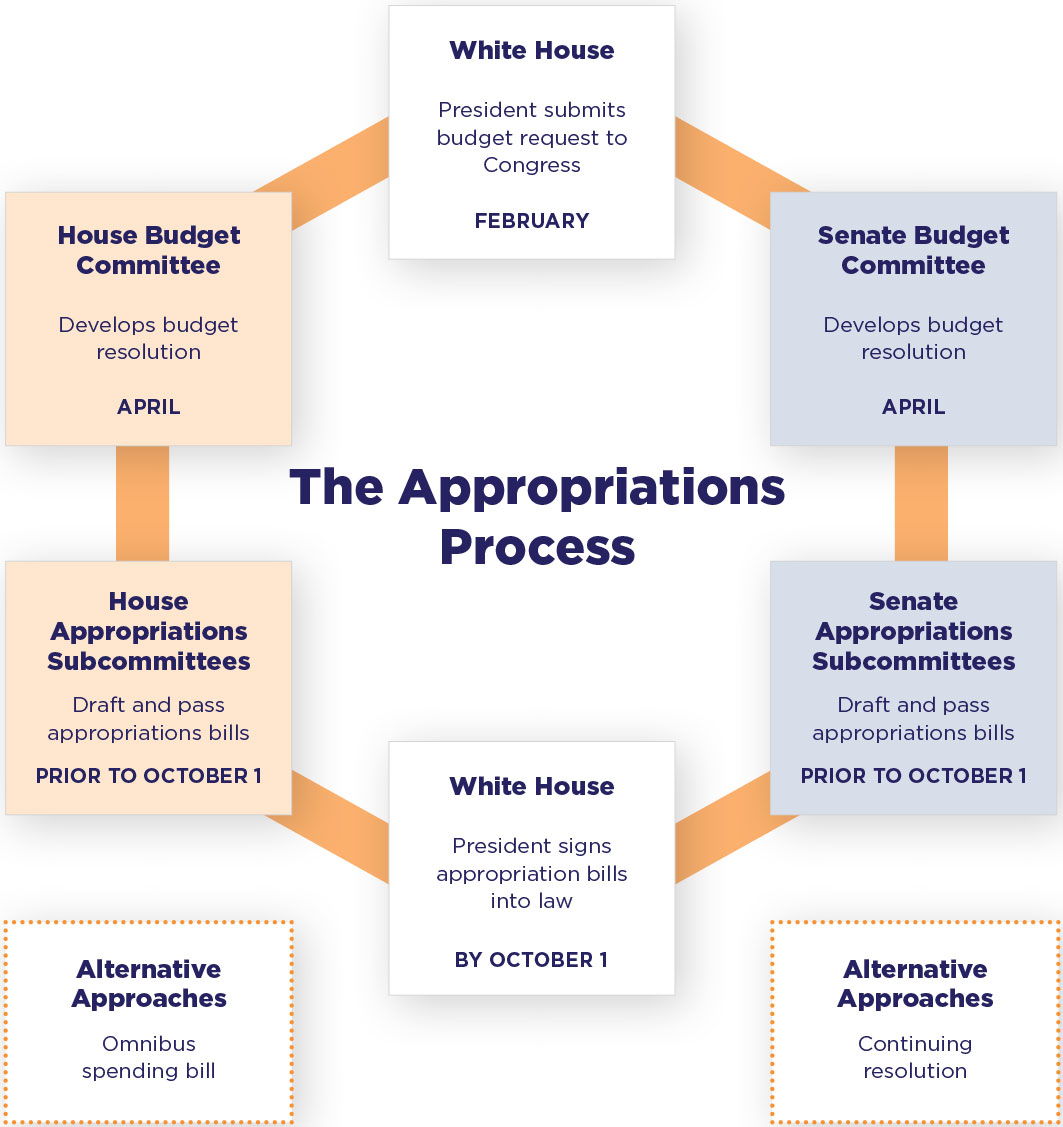
While the appropriations process has a general path for Congress and the Executive branch to follow, things often happen differently. For instance, when the prior fiscal year bills are completed late, this delays the President’s budget for the following year. Also, if Congress is unwilling or unable to pass a budget resolution or the appropriations bills (particularly when the government is divided) before the start of the new fiscal year, a government shutdown can occur. The “partial” shutdown from late 2018 to early 2019 was due to Congress’ inability to reach a joint budget resolution. In some cases, Congress will pass a Continuing Resolution or CR, to continue to fund the government at the current funding levels until an agreement can be reached.
So, what can you do?
While the appropriations process is somewhat complex to navigate, your advocacy can make a significant difference! Many patient communities have had great success moving their respective disease community priorities forward through Appropriations.
Pay attention to which Members of Congress take on important appropriations roles such as members of the Appropriations Committee and the Subcommittees responsible for health-related appropriation bills. Re-engage or consider engaging with these Members or your own Members on appropriations request to support research, public health, therapy development, access or other priorities to assist the rare disease community.