What is the Priority Review Voucher Program?
The Rare Pediatric Disease Priority Review Voucher (PRV) Program incentivizes pharmaceutical companies to develop treatments for rare pediatric diseases. The FDA operates the PRV Program, but it must be authorized by Congress.
The process to qualify for a PRV Program starts well before a treatment is approved, when the company developing the treatment must obtain Rare Pediatric Designation from the FDA. To be eligible, the drug must qualify for priority review and be the first approval for the drug’s active ingredient.
After a treatment with a Rare Pediatric Designation is approved by the FDA, the company is issued a PRV that can be used to obtain priority review for a treatment that wouldn’t otherwise qualify. Priority review means a treatment is generally reviewed by the FDA within a 6-month period rather than the standard 10-month period.
Once issued by the FDA, PRVs can be redeemed by the company in a future application or sold to another company, generating revenue for the seller. The revenue that they generate from selling a PRV is part of the incentive for companies to invest in developing treatments for rare pediatric conditions. Companies purchase PRVs to get treatments to market faster than the typical 10-month review period.
The ability to sell the voucher or obtain a faster review on a future application is a key incentive that allows many promising rare pediatric therapy development efforts to move forward when the risk of failure is high, clinical trial complexities are significant, and the potential market for treatment adoption is low. The result is more hope for kids and families dealing with devastating rare diseases.
To learn more about the PRV Program, check out this explainer video from our amazing RARE Young Advocates.
How does the PRV Program help the rare disease community?
The Creating Hope Act of 2012 (part of the Food and Drug Administration Safety and Innovation Act) established the PRV Program to help expedite the development and promotion of drugs for diseases that disproportionately affect children. Since then, the PRV Program’s impact has been undeniable, incentivizing the development of countless new treatment options across over 60 rare disease communities, most of which had no prior treatment options.
Developing drugs for rare pediatric diseases is particularly challenging due to the small populations affected, difficulties associated with conducting clinical trials for children, delays in diagnosis, and more.
- About 70% of rare diseases are exclusively pediatric onset and overall, 95% of rare diseases have no approved treatments.
- The impact of the PRV Program has continued to increase since the last reauthorization. A new incentive takes time to fully impact decision making since it takes an average of 15 years for a drug to be developed and approved by the FDA.
- Over 70 Rare Pediatric PRVs have been issued since 2012 for innovative treatments in over 60 diseases.
PRV Program Advocacy History
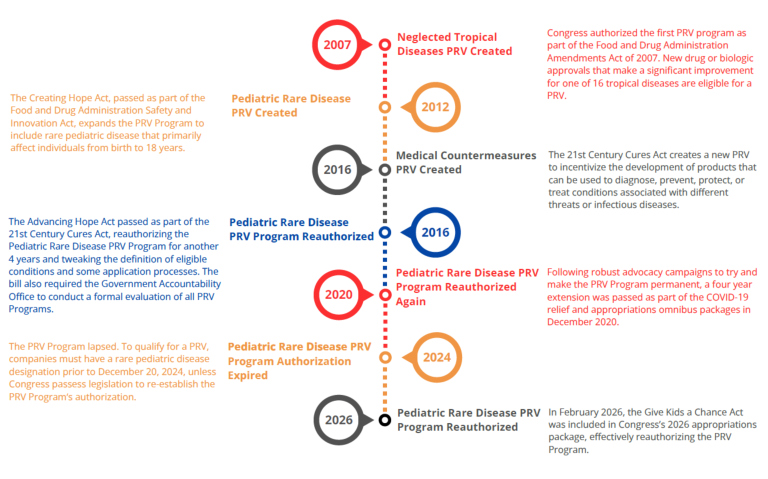
The Rare Pediatric Disease PRV Program was authorized by Congress in 2012 through the passage of the Creating Hope Act, which was included in the larger Food and Drug Administration Safety and Innovation Act. Since the PRV Program was authorized for a limited period of time, Congress must pass legislation to renew its authorization. It has now been reauthorized three times. The current authorization will expire on September 30, 2029.
Recent Reauthorization Efforts
The House included the reauthorization of the PRV Program within a larger bill called the Give Kids a Chance Act, which passed unanimously in September 2024. In late December 2024, a bipartisan healthcare policy package, including the Give Kids a Chance Act, was released and set to be included in the end-of-year government funding extension. Due to forces unrelated to the healthcare policy package or the rare disease community, most health provisions, including the PRV Program, Accelerating Kids Access to Care Act, and cancer research funding, were excluded from the final bill. Unfortunately, the PRV Program expired on December 20, 2024.
Thankfully, the Give Kids a Chance Act was reintroduced early in 2025, and in December 2025, the House passed it, including a five-year authorization for the PRV Program. Unfortunately, the attempt to pass the bill via unanimous consent in the Senate was unsuccessful.
In February 2026, the Give Kids a Chance Act was included in the larger funding bill passed by Congress, effectively reauthorizing the PRV Program.
After more than two years of advocacy, renewing this Program means that research, clinical trials, and new treatments for children can continue to advance.
PRV Timeline
Related Updates
Help us amplify the voices of the rare disease community to drive meaningful change and influence policy.