ICD stands for “International Statistical Classification of Diseases and Related Health Problems.” It is a standard classification system used around the world throughout the healthcare system and by government agencies and researchers to track and report diseases, disorders, injuries, and other health conditions.
The ICD coding system is maintained by the World Health Organization (WHO) and has roots dating back to 1893. It has gone through 11 major revisions over that time. The US and 150 other countries currently use ICD-10; ICD-11 became available on January 1, 2022. However, migration to a new ICD revision occurs at different rates across the world and can take several years to fully implement. There is no mandatory deadline for adoption and the previous version will remain in effect until the new one is adopted by a given country.
Why do ICD codes matter?
ICD codes are like a “lubricant” in the enormous global healthcare and biomedical research enterprise. Accurate and appropriate ICD codes help information move more swiftly and smoothly through the system. As described by the WHO, maintenance and use of this standard classification systems allows for:
- Easy storage, retrieval and analysis of health information for evidenced-based decision-making
- Sharing and comparing health information between hospitals, regions, settings and countries
- Data comparisons in the same location across different time periods
Consider the power of understanding which types of medical specialties are diagnosing a particular rare disease or having the ability to track changes in patients’ health outcomes after a new therapy is approved for their disease. A payer’s medical policy decisions for a new therapy might be based on an assessment of how many individuals covered by their plans have a particular diagnostic code in their record. These are the types of queries made possible through ICD codes. They are also the types of assessments that can be distorted by imprecise or out-of-date codes.
What do ICD codes mean to my life?
Every encounter you have with the healthcare system is documented through the use of ICD codes (for diagnoses and symptoms) and their cousins (CPT and HCPCS codes for procedures, services, drug, devices, vaccines, etc.). The way these codes are combined can affect whether and how much an insurance company or other payer will reimburse for that encounter. If a condition doesn’t have an appropriate ICD code, the physician will choose from existing codes for other conditions which could affect coverage and reimbursement for the care you receive. This also makes it hard to accurately trace the outcomes of that care since it isn’t linked to the specific condition for which it was provided, nor will you be recognized in the data system as having that condition. Finally, in the diagnosis process, physicians may be less likely to consider conditions without an ICD code.
Who should be interested in ICD codes?
The ICD system is carefully tended by dedicated professionals around the world. While anyone affected by or interested in health-related issues has reason to know about ICD codes, the subject is most important to people affected by or interested in diseases and health conditions for which improper (or lack of) classification adds to the burdens experienced by affected patients, caregivers, and healthcare systems. By helping draw attention to the public health-related need for coding updates and developing solid evidence to support an addition or change to a specific coding structure, you can be part of the worldwide effort to support better research and care.
How can I find out whether the disease I’m interested in has an ICD code?
There are numerous public databases online, so start by entering “ICD code for [disease/condition of interest]” into any search engine. The results of that search may take you to descriptions that are used for different purposes, such as a “billable diagnostic code,” and may show how that disease/condition is “indexed” to other disease and injury classifications. It may also yield a description of the code’s history – how it has changed over time – and other conditions with which that code is associated. You may need to seek the advice of medical and/or scientific advisors to determine whether the classification as it currently exists is appropriate. With the ever-evolving scientific understanding of the human body and diseases of all types, it’s impossible for the ICD to be fully up to date.
If you don’t get any results on your first search, try searching a few different ways (especially for diseases that may go by several names) on different search engines before concluding that the condition of interest doesn’t have a code. If you still come up empty, consult a few physicians with expertise in your disease/condition of interest about whether a specific code exists and/or how they code for that diagnosis. This is important information you will definitely need to have if you embark on a code proposal. (See “How do new codes get added or codes get revised?” below.)
You can also search the “pre-release” version of the ICD-11 to see if the disease you’re interested in is reflected in it; ICD-11 will start going into effect in 2022. (See “What is an ICD code?” above for more information.)
If you are searching for an ICD code for a rare or genetic disease and determine there is not one, make sure the disease is recognized in the National Institutes of Health’s Genetic and Rare Disease (GARD) listing of rare diseases. This is an important first step before attempting to secure a new ICD code.
ICD Code Fun Fact: For the fiscal year ending 9/30/20, there were 72,184 unique ICD-10 codes in the US version of the system known as ICD-10-CM. ref
How do new codes get added, or codes get revised?
As you might anticipate, an international standardized classification system is built for endurance rather than speed. At the international level, WHO is responsible for maintaining and updating the ICD. In the US, maintenance of diagnostic codes is the responsibility of the National Center for Health Statistics (NCHS), part of the Centers for Disease Control and Prevention (CDC). Procedure codes fall under the remit of the Centers for Medicare and Medicaid Services (CMS).
Updates are managed by the ICD-10 Coordination and Maintenance Committee, a joint effort of NCHS and CMS. Codes are updated annually in October of each year based on proposals and evidence submitted and carefully reviewed over the previous 18-24 months. The Committee bases its decisions for code updates on the strength of evidence presented, including a public health-related reason for the change, sound rationale for the proposed code restructuring, and demonstrated consensus among experts that it is warranted. They will also evaluate whether there might be unintended consequences of a proposed coding change, including how it might impact tracking for conditions linked to the existing and proposed codes. As you’re likely beginning to appreciate, altering the code is a delicate matter that must be approached with diligence and care.
What role can patient advocacy organizations play in updating ICD codes?
If it is suspected or determined that the manner in which a disease or condition is represented in ICD warrants reconsideration, patient advocacy organizations can play a central role in bringing together the various stakeholders whose expertise and experience may be needed to develop an evidence-based proposal to present to the ICD-10 Coordination and Maintenance Committee. Several patient advocacy organizations have led successful initiatives to add new ICD codes or revise existing codes. It takes partnership, persistence, and patience, but it can be done!
ICD Code Roadmap
The RARE Foundation has created an ICD Code Roadmap to help patient advocacy leaders and their partners understand, evaluate their role, and navigate the process.
For all who seek to better understand how diagnosis codes are assigned, updated and revised in the United States’ health information system, this ICD Code Roadmap is for you. The Roadmap provides all the information you will need to determine whether and how to get involved in the continuous process of refining the diagnostic coding system used in the U.S.
In addition to this FAQ, please make use of these resources and feel free to share them widely:
- How ICD codes Impact the Rare Disease Community Journey: A lively, 2-minute animated video useful for sharing with Board members, medical and scientific advisors, volunteers and others whom you may want to help better understand the process
- Readiness Assessment Survey: This tool provides a set of questions and self-ratings to help patient advocacy leaders assess their readiness to engage in the ICD code revision process and highlights capabilities that can improve chances for success
Upon learning that new codes for Dravet syndrome were going to become effective, we immediately went to work to spur awareness and adoption of the new codes. They won’t benefit anyone if healthcare professionals didn’t know they exist.
Mary Anne Meskis
Executive Director, Dravet Syndrome Foundation
Case Studies
Castleman Disease

“The code specific to Castleman disease wouldn’t exist if we hadn’t lobbied for it. Someone had to turn hope into action to make this a reality. If you don’t do it, oftentimes no one else will.” – David Fajgenbaum, M.D.
Eleven weeks passed between the date David Fajgenbaum, M.D., was first hospitalized and when he was diagnosed with HHV-8 negative, idiopathic multicentric Castleman disease and given his first chemotherapy treatment in 2010. Even with the vast healthcare resources David and his physician father could harness, David came close to death numerous times over those 11 weeks and the next 3 years, a harrowing story he chronicles in his memoir, “Chasing My Cure.”
Once he had a name for the disease he was fighting, David set out to tackle it. One discovery of many in this quest was that Castleman disease wasn’t part of the formal health information nomenclature – it lacked a specific ICD code. David understood from his medical training that accurate codes are crucial to tracking, reimbursement, gaining access to therapies and much more. Yet Castleman disease was swept into a “miscellaneous code, one that covered a number of hard-to-categorize diseases,” as he described it. In 2014, he and Dr. Frits van Rhee, along with colleagues from the Castleman Disease Collaborative Network he co-founded, went to work to secure a new code specific to Castleman disease.
“I emailed the folks at CDC multiple times for guidance, and they were very helpful when I finally received a response,” he recalled. “I drafted a proposal that was improved upon by Dr. van Rhee and other members of our Scientific Advisory Board. In it, we requested the addition of three codes for specific subtypes of Castleman disease. Letters of support were sent by 15-20 patients, physicians and researchers, and I kept the heat on. I presented our proposal at the ICD C&M meeting held in September 2014; after that, long periods went by without any information or response from the CDC staff. The status of our request wasn’t clear. We had not engaged any coding experts to help us, so I had no idea what to expect or when we might hear something.”
More than two years later, in 2017, David was looking through his medical reports following a recent doctor visit. He noticed an unfamiliar ICD code, D47.Z2, on a billing statement. He recalls that moment in his book, “Confused, I googled it. It was Castleman disease. Our very own code.” Upon further exploration, David learned that a single code for Castleman disease had been approved and went into effect on October 1, 2016. The subtype codes were not accepted as proposed, based on the Committee’s determination that Castleman disease was too rare to warrant three separate codes. Although chagrined at the idea that a “burn due to water skis on fire” warranted three codes, he decided one code for Castleman disease was better than no code. “It wouldn’t exist if we hadn’t lobbied for it. Someone had to turn hope into action to make this a reality. If you don’t do it, oftentimes no one else will. We’ve come a long way.”
Dravet Syndrome

Upon learning that new codes for Dravet syndrome were going to become effective, we immediately went to work to spur awareness and adoption of the new codes. They won’t benefit anyone if healthcare professionals didn’t know they exist.” – Mary Anne Meskis
Like many rare disease advocates, Mary Anne Meskis’s determination to problem-solve is rooted in personal experience. The youngest of her three children, Elliot, has Dravet syndrome, a rare catastrophic form of epilepsy that begins in the first year of life. She was among a group of parents who founded the Dravet Syndrome Foundation in 2009, and she became the organization’s first executive director in 2012, shepherding its mission to expedite research and find better treatments and a cure.
One of the challenges Mary Anne recognized was the manner in which Dravet syndrome was coded in health information systems – it was included in a general code for “Other epilepsy and recurrent seizures,” G40.8. “This broad category didn’t encompass the many symptoms of Dravet syndrome, which include behavioral and developmental delays, movement and balance issues, orthopedic conditions, chronic infections, sensory integration disorders and dysautonomia. It made it more difficult to secure coverage for indicated medicines and medical testing to address all healthcare needs of a person with Dravet syndrome,” she stated. By 2017, there were several promising therapies for Dravet syndrome in various life science companies’ pipelines, including some for a subtype associated with a mutation of the SCN1A gene, which accounts for over 80 percent of those diagnosed. She knew from other advocacy leaders that coding issues can make it more difficult for patients to access therapies (if and) when they are approved.
She initiated discussions about seeking a specific ICD code for Dravet syndrome with the Foundation’s Medical Advisory Board. In January 2018, they submitted a proposal to establish a new subcategory and four subtype-specific codes for Dravet syndrome. It reflected the importance of differentiating between Dravet syndrome with and without evidence of a SCN1A mutation, as well as with and without status epilepticus.
Over the next two years, Mary Anne and the group monitoring and responding to developments in the ICD C&M Committee’s deliberations worked to address comments. Dr. Ian Miller, a pediatric epileptologist, presented to the Committee on behalf of the Foundation twice in person. Mary Anne accompanied him too. “We went to Baltimore not knowing what time our proposal would come up. We listened intently to the other presentations and the discussion that followed ours and others, but we received little information about the status of the proposal between meetings,” she recounted.
The Committee staff’s presentation at the meeting held in March 2019 indicated that the third iteration of the Dravet syndrome proposal released on that date had been “reviewed and supported” by the American Academy of Neurology at the Committee staff’s request. Dravet syndrome was not discussed at the meeting held in September 2019; it wasn’t clear what that meant. However, in January 2020, two years after submitting the initial proposal, Mary Anne received word that the Committee had approved a new subcategory for Dravet syndrome under the G40 Epilepsy code, along with two codes for specific subtypes. These would become effective as of October 1, 2020.
As Mary Anne notes, the process didn’t end with that news, as welcome as it was. “We immediately went to work to spur awareness and adoption of the new codes. They won’t benefit anyone if healthcare professionals don’t know they exist. We issued an announcement in February 2020 to set the stage and a press release after they went into effect, in November 2020, using the heightened visibility of Epilepsy Awareness Month as leverage to spread the word. We have one-page fact sheets and business-card-size reminders that our families can use to make sure their healthcare providers know about and use the codes. We keep a steady drumbeat going.”
The timeline and iterations of the Dravet syndrome proposal are mapped below to illustrate how the process unfolds when comments offered at the meeting, received in writing afterwards or actively sought out from authoritative sources prompt revisions.
1/5/18 – DSF proposal submitted
- G40 Epilepsy
- G40.8 Other epilepsy and recurrent seizures
- G40.83 Dravet syndrome
- G40.831 …… intractable, without SCN1A mutation, without status epilepticus
- G40.832 …… intractable, without SCN1A mutation, with status epilepticus
- G40.833 …… intractable, with SCN1A mutation, without status epilepticus
- G40.834 …… intractable, with SCN1A mutation, with status epilepticus
- G40.83 Dravet syndrome
- G40.8 Other epilepsy and recurrent seizures
1/8/18 – Deadline for new proposals to be reviewed at March 2018 meeting
3/6/18 – Proposal presented by ICD C&M Committee Staff
- G40 Epilepsy
- G40.8 Other epilepsy and recurrent seizures
- G40.83 Dravet syndrome
Polymorphic epilepsy in infancy (PMEI)
Severe myoclonic epilepsy in infancy (SMEI)- G40.831 Dravet syndrome, intractable, with SCN1A mutation, with status epilepticus
- G40.832 Dravet syndrome, intractable, without SCN1A mutation, without status epilepticus
- G40.833 Dravet syndrome, intractable, without SCN1A mutation, with status epilepticus
- G40.839 Dravet syndrome, intractable, with SCN1A mutation, without status epilepticus and Dravet syndrome not otherwise specified
- G40.83 Dravet syndrome
- G40.8 Other epilepsy and recurrent seizures
5/11/18 – Deadline for comments on proposals discussed at March 2018 meeting
9/11/18 – Proposal presented by ICD C&M Committee Staff
- G40 Epilepsy
- G40.8 Other epilepsy and recurrent seizures
- G40.83 Dravet syndrome
- G40.831 Dravet syndrome, intractable, with status epilepticus
- G40.832 Dravet syndrome, intractable, without status epilepticus
- G40.839 Dravet syndrome unspecified, polymorphic epilepsy in infancy (PMEI), severe myoclonic epilepsy in infancy (SMEI), Dravet syndrome not otherwise specified
- G40.83 Dravet syndrome
- G40.8 Other epilepsy and recurrent seizures
11/13/18 – Deadline for comments on proposals discussed at September 2018 meeting
3/5/19 – Proposal presented by ICD C&M Committee Staff
- G40 Epilepsy
- G40.8 Other epilepsy and recurrent seizures
- G40.83 Dravet syndrome
Polymorphic epilepsy in infancy (PMEI)
Severe myoclonic epilepsy in infancy (SMEI)- G40.831 Dravet syndrome, intractable, with status epilepticus
- G40.832 Dravet syndrome, intractable, without status epilepticus and Dravet syndrome not otherwise specified
- G40.83 Dravet syndrome
- G40.8 Other epilepsy and recurrent seizures
10/1/20 – New codes go into effect
- G40 Epilepsy
- G40.8 Other epilepsy and recurrent seizures
- G40.83 Dravet syndrome
Polymorphic epilepsy in infancy (PMEI)
Severe myoclonic epilepsy in infancy (SMEI)- G40.833 Dravet syndrome, intractable, with status epilepticus
- G40.834 Dravet syndrome, intractable, without status epilepticus
- G40.83 Dravet syndrome
- G40.8 Other epilepsy and recurrent seizures
Duchenne and Becker
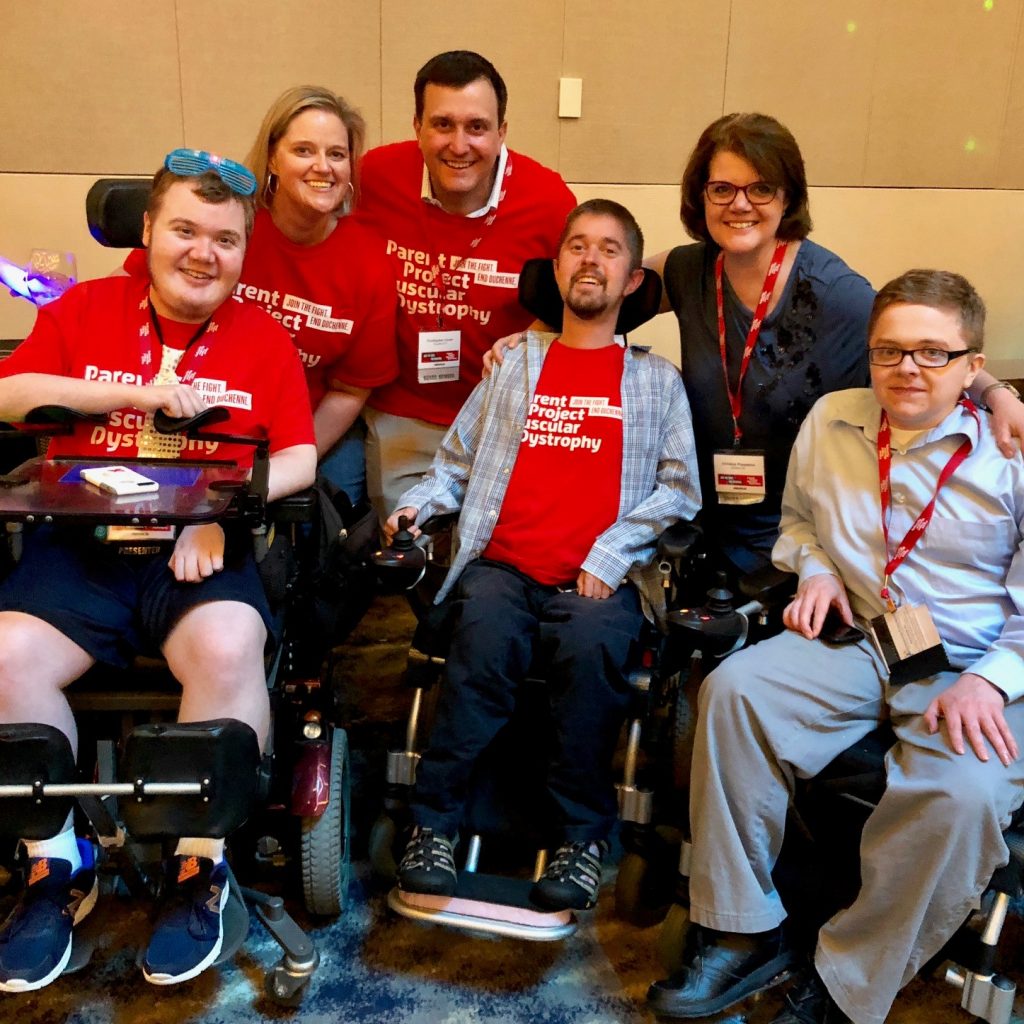
“It is gratifying to have data as confirmation of the importance of the work we – and so many other leaders – have done on behalf of their communities to improve access to care for individual patients, better understand care outcomes and improve research efforts. While few may know what a powerful tool an ICD code can be, the time we dedicated to refining the ICD code for Duchenne served as a force-multiplier for our community.” – Annie Kennedy, Chief Mission Officer, RARE Foundation
Annie Kennedy became familiar with ICD codes early in her career when she was working in a neuromuscular clinic. She saw how codes were applied, singularly and in combination, to document patients’ health statuses and to help them gain access to needed treatment and services. Years later, in 2010, while working on a study of the economic burden of ALS, spinal muscular atrophy (SMA), Duchenne muscular dystrophy and myotonic muscular dystrophy, Annie first came to appreciate how vital these codes are to research. “Our analysis of direct and indirect costs attributable to the four diseases relied on ICD codes. There wasn’t a specific code for Duchenne, so those costs were ‘hiding’ within the general muscular dystrophy code and impacted our ability to develop distinct evidence around each disease community,” she said.
A couple years after that, she was working with the CDC to attempt to identify 100 percent of the cases of Duchenne in South Carolina as a pilot project under the MD STARnet surveillance system. Annie saw firsthand how slow and expensive the process was. De-identified information was being manually extracted from physician’s offices and then a sophisticated algorithm had been developed to confirm cases of Duchenne for data entry. “The next phase of that project was going to involve additional states. This surveillance data was critical and powerful but to expand beyond the few states we currently were working in, we would need to get a specific ICD code for Duchenne. That lit a fire.” Annie joined Parent Project Muscular Dystrophy (PPMD) at about this same time, and PPMD founder and CEO, Pat Furlong, immediately gave Annie the green light to work on getting Duchenne a code.
While she was assembling the coalition of stakeholders, attending ICD C&M Committee meetings as background and talking with other advocacy leaders (including Dr. David Fagjenbaum) about their experiences developing coding proposals, the first genetically targeted therapy for Duchenne was approved in September of 2016 and launched into a complex access environment. “While we’d understood that patient access wasn’t going to be automatic, we had not anticipated just how difficult it would be. We found ourselves engaging closely with public and private payers around the available data that could help inform decision-making around patient community eligibility and clinical outcomes. In one instance, a state’s Medicaid program was reviewing an FDA-approved therapy for a small subpopulation of Duchenne patients and had estimated that 500 patients in that state would be eligible for the therapy. Given the potential budgetary impact, they told us it would be unlikely the product would be covered because their state just couldn’t absorb the costs for the 500 patients they estimated would be eligible for treatment. Shocked by that number, we learned they had used the ICD code for “general” muscular dystrophy to make their determination. That included a lot more people than would have the specific genetic subtype of Duchenne that the therapy was targeted to treat,” Annie recounted. Working with MD STARnet and PPMD’s provider network, they determined that just three individuals in the state would be eligible for the new therapy. That crucial information led to a commitment to cover the treatment); it also underscored the urgent need for a unique ICD code to avoid this happening in 49 other states.
PPMD worked swiftly with other advocacy organizations, clinicians, researchers and a coding professional to develop a proposal. “We had to determine whether to request two separate codes for Duchenne and Becker or to combine them under one code.” Annie explained further, “The clinical understanding of the two subtypes of muscular dystrophy was evolving fast, and we didn’t want to risk the possibility that there might be unintended consequences around treatment and benefit eligibility for individuals living with Becker if they had a separate code. Ultimately, we decided to request a single code for Duchenne or Becker (combined), along with a separate code for Facioscapulohumeral muscular dystrophy.” The proposal was submitted, reviewed and approved in 2017, and the codes became effective on October 1, 2018.
To help understand the impact of the new code over the first two years of implementation, Sarepta, the company who has developed and secured approval for three targeted muscular dystrophy therapies to-date conducted an analysis, drawing on consultations with clinical experts, publications, claims data and coverage policies. They determined that the code for Duchenne and Becker is widely used and is cited in coverage policies for drug therapies, genetic testing and nerve conduction testing. Clinicians report that the unique code is helpful in identifying and tracking patients for purposes of delivering clinical care, recruiting patients into studies and measuring health outcomes that enable quality improvement. The code also reduces administrative burdens by making billing easier. Comparative studies of Duchenne and Becker are hampered by the use of a single code for both, but the combined data set is growing and the overall benefits, so far, seem to outweigh drawbacks. Additionally, the code has helped to develop a more complete understanding of the patient journey, identify physicians and care centers with newly diagnosed patients, and refine patient censuses by state and age.
“As a patient organization, it is sometimes hard to know which efforts to direct the precious commodities of time and resources towards. It is gratifying to now have this data as confirmation of the importance of the work we – and so many other leaders – have done on behalf of their communities to improve access to care for individual patients, better understand care outcomes and improve research efforts. While few may know what a powerful tool an ICD code can be, the time we dedicated to refining the ICD code for Duchenne served as a force-multiplier for our community,” Annie stated with conviction.
Friedreich’s Ataxia
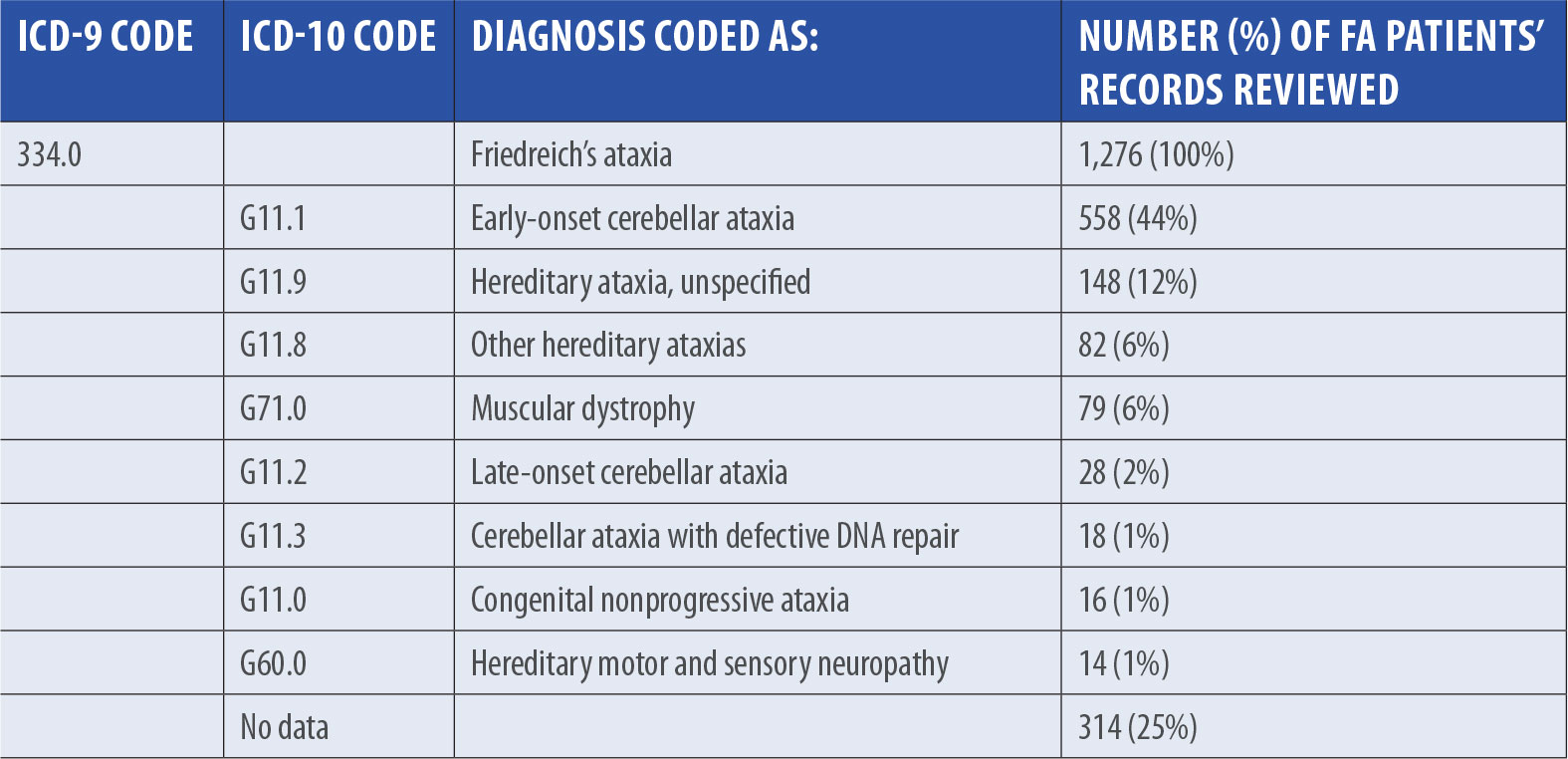
“We had information that illustrated just how messy the coding had become under ICD-10-CM. Of 1,276 FA patients who had been correctly identified under the ICD-9-CM code for FA (334.0), only 558 (44%) were subsequently coded with the new ICD-10-CM code, G11.1.” – Susan Walther, M.S., L.C.G.C.
When the U.S. converted from ICD-9 to ICD-10 in 2015, the intent was for the diagnostic codes to become more specific and more accurate. In spite of this intent, the ICD code for Friedreich’s ataxia (FA) became less specific in the transition. FA went from having a specific code (334.0) in ICD-9-CM to being grouped under a code for “Early-onset cerebellar ataxia” (G11.1) along with conditions for which the diagnosis, disease course, management and treatment approaches vary significantly from those for FA. Several comorbidities, including cardiomyopathy and diabetes, are unique to FA as compared to these other cerebellar ataxias.
Recognizing the need to recover that greater degree of specificity for research purposes, the benefit of patient care and for facilitating payer approval of approved treatments, Susan Walther, M.S., L.C.G.C., director of patient engagement for the Friedreich’s Ataxia Research Alliance (FARA), worked with physicians in the Collaborative Clinical Research Network for FA to initiate a request for a specific ICD-10-CM code.
Among the evidence they compiled to support the request was a review of diagnostic codes cited in the health records of 1,276 FA patients. Susan recalls, “This data had been shared by an industry partner months before we determined the need to submit a proposal for a new code. As I was drafting our request, I remembered we had information which illustrated just how messy the coding had become under ICD-10-CM. These 1,276 patients had been correctly identified under the ICD-9-CM code for FA (334.0), but only 558 (44%) were subsequently coded with the new ICD-10-CM code, G11.1.” There were eight other ICD-10-CM codes used in charts of 404 patients and there was no additional data in the records for the remaining 25 percent, as shown below:
Susan used this data and other evidence sources to prepare the proposal in collaboration with advisors from the NCHS. They recommended a subcategory and a code that would move FA out of the group of early-onset cerebellar ataxias, given it is not an accurate placement. After approximately six months of discussion and proposal revisions with NCHS staff, FA was placed among the topics to be discussed at the ICD C&M Committee’s September 2019 meeting. Susan presented the clinical overview; in it she included the data from the chart review. David Berglund, M.D., presented the agency’s proposal for a revised coding structure. He proposed maintaining the G11.1 category for “early-onset cerebellar ataxia” and creating new codes for early-onset cerebellar ataxia, unspecified (G11.10), Friedreich’s ataxia (with two subtypes listed at G11.11) and other early-onset cerebellar ataxia (with four subtypes listed at G11.19).
“The time I had to present was very short, so I drew on my experience as a genetic counselor and focused on details about FA that would support ways in which a new code would bring greater clarity to the coding structure as a whole. The lunch break followed our segment, and I was approached by one of the coding professionals in attendance who said my presentation was convincing. She also told me we probably wouldn’t hear anything else about the status of our request until the new approved codes came out the following year. It was an eye-opening experience as to how difficult it would be to find information on approval or denial of our request,” Susan said.
A year later, on October 1, 2020, a new ICD-10-CM code went into effect for FA, G11.11. The new code was too similar to the previous code, but it felt to Susan like a victory, nonetheless. To help spur adoption, FARA issued a press release, posted a short video describing the importance of using G11.11 for FA and created fact sheets for use by families and health care professionals to migrate to the new code. “Working to remind providers to simply add another ‘1’ to the code is worth it, if by doing so patients will experience improved clinical management. Over time, we hope it helps us better track the overall prevalence of FA, the onset of various related symptoms and hospitalizations, and that it will expedite coverage and reimbursement of the care FA patients rely on, especially when disease-modifying treatments for FA come to market.”
SYNGAP1

“The news that Angelman’s syndrome had been assigned a unique ICD code made me think that ICD codes could be a key to more efficiently identifying SYNGAP1 families and families with other rare forms of intellectual disabilities. I learned first-hand that it’s a painstaking process.” — Hans Schlecht, M.D., M.M.Sc
Hans Schlecht, M.D., M.M.Sc., added “patient advocate” to his list of titles after his son, Erich, was diagnosed via whole exome sequencing with a pathogenic SYNGAP1 variant. This deficiency causes a spectrum of intellectual and developmental delays, seizures, low muscle tone and disordered sleep and behavior. Putting his medical training and professional network to use for the community, Hans joined fellow SYNGAP1 advocates in efforts to advance research and care.
It was at a 2017 meeting hosted by Global Genes where Hans first recognized the opportunity to leverage big healthcare systems’ databanks to achieve a better understanding of the prevalence of rare conditions and help families affected by them to connect with one another. “I talked to dozens of people, each of whom attended in hopes of finding another person who might be able to help their loved one with a rare disease. I knew that health systems like Kaiser have huge data warehouses that could be used to identify cases, both for the benefit of research and the individual. Then came the news that Angelman’s syndrome had been assigned a unique ICD code. It made me think that ICD codes could be a key to more efficiently identifying SYNGAP1 families and families with other rare forms of intellectual disabilities.”
Upon learning about the painstaking process by which ICD-10 codes in the U.S. are assigned, Hans initially conceived of a means to link different types of coding systems together. For example, the Human Gene Organization (HUGO) Gene Nomenclature Committee (HGNC) is the global authority for approving unique symbols and names for all the building blocks of the human genome to allow for “unambiguous scientific communication.” Hans’ vision was to tie the symbols used by HGNC together with codes issued under the ICD. Some experts with whom he shared this idea found it intriguing, but ultimately advised him that the ICD-10 code was too “brittle” for such a sweeping change, especially with an international update of the entire coding system coming into effect in 2022.
With that, in 2019 Hans set out to develop a proposal for SYNGAP1 to be assigned a unique ICD code and he helped about a dozen other advocates prepare separate proposals for related causes of intellectual disability. Initial feedback from the ICD Coordination & Maintnenace Committee staff prompted revisions and some of the advocates dropped from the process. Hans submitted a proposal on behalf of the SynGAP Research Fund and coordinated with another from Bridge the Gap, another SYNGAP patient advocacy organization, offering two distinct options for the tabular modifications. One would place it within the section for “G93.49 – Other encephalopathy” as “G93.4902 SYNGAP1 Encephalopathy.” The second option would place the new code within “F78 – Other intellectual disabilities” as “F78.02 – Intellectual disability secondary to pathogenic SYNGAP1 variant.” This time SYNGAP1 was added to the agenda for the March 18, 2020 meeting of the ICD C&M Committee. Codes adopted as a result of presentations at this meeting would go into effect on October 1, 2021.
At the meeting, physician-researcher Constance L. Smith-Hicks, M.D., Ph.D., presented a five-minute review of the scientific and medical understanding of SYNGAP1. David Berglund, M.D., of the ICD C&M Committee staff followed with a coding proposal based on the second option in Hans’ proposal to create a new subcategory, “F78.A – Other genetic-related intellectual disabilities.” It also proposed two new codes: “F78.A1 – SYNGAP1-related intellectual disability” and “F78.A9 – Other genetic-related intellectual disability,” which would index genetic several variants including: CHAMP1, HNRNPH2, SATB2, SETBP1 and STXBP1. These were some of the variants for which other advocates had submitted initial proposals. [Note: See page 55-56 of the proposal packet for the specific proposal presented by the agency at the meeting.]
While presenting the SYNGAP1 proposal, Dr. Berglund questioned the known prevalence of the genetic variants that would be indexed under the F78.A9 code. He stated, “Although we do not have absolute cut-offs as to when a rare disease should have a specific separate code, we will invite comment from the public about the issue of how common – as opposed to rare – something should be when we are considering assigning a separate, specific code.” He also raised a question about the implications for SYNGAP1 and related conditions if a code was created within the section for intellectual disabilities, as opposed to the one for encephalopathies. “There are over 100 genetic mutations that can cause intellectual disabilities; which ones should we index? How do we choose which to index if we place the SYNGAP1 code here?,” he asked. A member of the audience posed a question about such implications, which brought the discussion to an end due to time constraints.
The COVID-19 pandemic placed new demands on the ICD C&M Committee to keep pace with the rapidly evolving understanding of that disease’s effect on human health and how to capture it in the health information system. Hans waited a few months before following up on the March 18, 2020 meeting and subsequent comment period to check in with Committee staff. “I was told no decisions had been made,” he said. “Based on their deadlines and once-a-year update process, now the earliest effective date for a SYNGAP1 code would be October 1, 2022. I understand that it’s a struggle to determine the best way to implement rare diseases in the ICD code, but we’re losing time. The prevalence of SYNGAP1 and health outcomes related to it are being obscured because patients are classified in any number of general or ‘not-otherwise-specified’ codes. Yet, SYNGAP1 and other genetically determined types of intellectual disabilities are disadvantaged from being assigned a specific code because the prevalence is unknown and possibly below some minimum threshold. Without a code, it is difficult to document their prevalence. That seems like a solvable problem to me.”
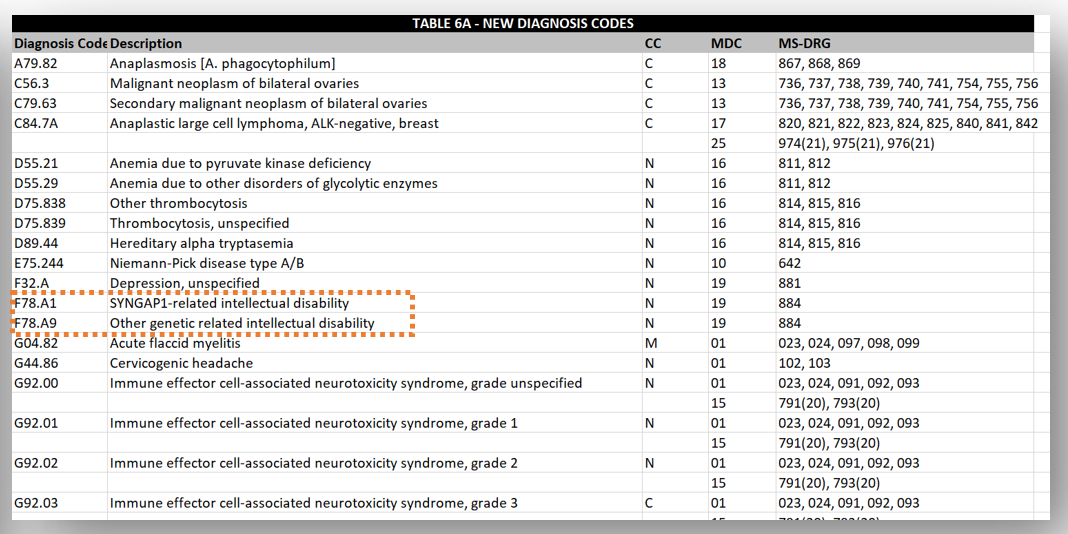
Neither the September 2020 nor March 2021 ICD C&M Committee meetings addressed comments or revised proposals related to SYNGAP1 or the other genetic variants causing intellectual disabilities listed in the agency’s March 2020 proposal. Yet, on April 27, 2021, the CMS Inpatient Prospective Payment Systems (IPPS) Proposed Rule notice included a new ICD-10-CM code for SYNGAP1, F78.A1. It also included a code, F78.A9, for “Other genetic related intellectual disability.” There are no indexed conditions listed under F78.A9 in this publication, although other updates and indexes may be announced in May or June, consistent with the usual schedule for full information on new codes.
Looking ahead to implementation of these codes and the potential benefit to SYNGAP1 patients, Hans reflected on the collaboration to get to this point. “So much of scientific research is beyond the control of the patient advocate but getting an ICD code is within their direct ability and, as such, should be a high priority for time and effort,” he said.
Visit the SYNGAP1 Research Foundation’s ICD code page for more information.
Limb Girdle Muscular Dystrophy
“Among the community stakeholders I approached about developing an ICD-10-CM coding structure, I found varied levels of interest in and understanding of ICD codes and their importance, so I followed with education about the process, why it mattered and why they should participate. Ultimately, it yielded a ‘big tent’ coalition of stakeholders willing to work with MDA, weigh in on proposal drafts and lend their ongoing support to the effort.” – Paul Melmeyer
With 34 known distinct genetic subtypes of limb girdle muscular dystrophy (LGMD), Paul Melmeyer, vice president for public policy and advocacy at the Muscular Dystrophy Association (MDA), knew he had his work cut out for him as he set out to develop and advance a consensus proposal for an evidence-based ICD-10 coding structure. His prior work on ICD coding issues while on staff at the National Organization for Rare Disorders (NORD) prepared him for the task. The burgeoning investment in developing gene-specific therapies for the LGMDs made it an urgent one.
Other forms of muscular dystrophy, namely myotonic, Duchenne, Becker and facioscapulohumeral, had specific codes, but LGMD was listed under a code for “Other specified muscular dystrophies.” To develop a strawman structure, Paul relied on proposals developed by Parent Project Muscular Dystrophy (for Duchenne and Becker) and other advocacy organizations, as well as coding experts who understood both the science of medical coding and the ICD C&M Committee’s expectations and evidence requirements. He reached out to various patient advocacy organizations serving the LGMD community, physicians, researchers and federal agency partners. Paul reported, “I found varied levels of interest in and understanding of ICD codes and their importance, so I followed with education about the process, why it mattered and why they should participate. Ultimately, it yielded a ‘big tent’ coalition of stakeholders willing to work with MDA, weigh in on proposal drafts and lend their ongoing support to the effort.”
The proposal submitted to the ICD C&M Committee in December 2020 recommended a total of 12 subcodes: this includes six for the most prevalent LGMD subtypes and four for other subtypes for which there are advanced clinical therapeutic programs that could result in approved therapies within the next five years. These 10 new subtype specific codes would capture more than half of the LGMD community. According to the proposal, “The remaining LGMD population members will be captured in the two remaining codes we are nominating for LGMD: ‘Other genetically confirmed limb girdle muscular dystrophy subtype’ and ‘Limb girdle muscular dystrophy, unspecified.’ The remaining 24 subtypes can be considered for unique ICD-10-CM codes at a later date as therapeutic development advances.”
In further support of the nomination, the proposal included a table with prevalence estimates and citations for 8 of the 34 identified LGMD subtypes. The proposal states, “It is estimated that each of the other 24-identified LGMD subtypes affect fewer than three per one million individuals, with most if not all affecting fewer than one individual per million. This natural division in prevalence of LGMDs makes for a fairly apparent division between the more prevalent LGMDs that we are nominating for ICD-10-CM codes and the LGMD subtypes that do not meet our prevalence threshold.” Two other subtypes, both autosomal dominant forms linked to specific genetic mutations for which the recessive forms met their inclusion criteria. This was done to avoid potential confusion if only the recessive forms had been included.
In keeping with the big-tent strategy set from the beginning, the proposal was submitted under the auspices of nine patient advocacy organizations: Coalition to Cure Calpain 3; CureLGMD2i; Jain Foundation; Kurt+Peter Foundation; LGMD Awareness Foundation; LGMD2i Research Fund; LGMD2L Foundation; Muscular Dystrophy Association; and The Speak Foundation. It was also signed by the 10 clinical experts, most of whom lead the Limb-Girdle Muscular Dystrophy Clinical Research Network (LGMDCRN). It acknowledged contributions made to the process by the team at the Centers for Disease Control and Prevention responsible for MD STARnet, staff of biopharmaceutical companies developing therapies for LGMD subtypes, physical therapists who routinely treat individuals with an LGMD, experts in ICD-10-CM coding practices, medical societies representing medical professionals who treat individuals with an LGMD and other stakeholders.
Creation of codes for LGMD subtypes was among the topics discussed at the March 9, 2021 meeting of the ICD C&M Committee. One of the LGMDCRN signatories, Nick Johnson, M.D., M.S.C.I., F.A.A.N., provided the ten-minute clinical overview of LGMD. David Berglund, M.D., from the ICD C&M Committee staff presented the agency’s proposed coding structure, which reflected a different grouping strategy for the 34 subtypes under a total of 11 added codes. At times Dr. Berglund questioned whether the combined subtypes within a grouping would result in combined prevalence of more or less than one case per million. He also invited comments in writing on the overall approach to creation of ICD-10-CM codes for rare conditions.
As this publication went to press, the organizations and individuals involved in developing the initial proposal were coalescing support for the proposal across all LGMD stakeholders by circulating a petition within the patient community, collecting endorsements from medical professionals familiar with LGMD, and seeking support from all relevant stakeholder groups.
- Click here to read the proposal for ICD codes for LGMDs
- Click here to read the community letter of support